Call us (863) 858-5554
HealthFlex
×
  • Home
  • About Us
    • Check Your Coverage
    • Insurance & Self-pay Options
    • Client-Centered Therapy
    • Crisis and After-Hours Care
    • Privacy Policy
  • Specializing In
    • Specializing In
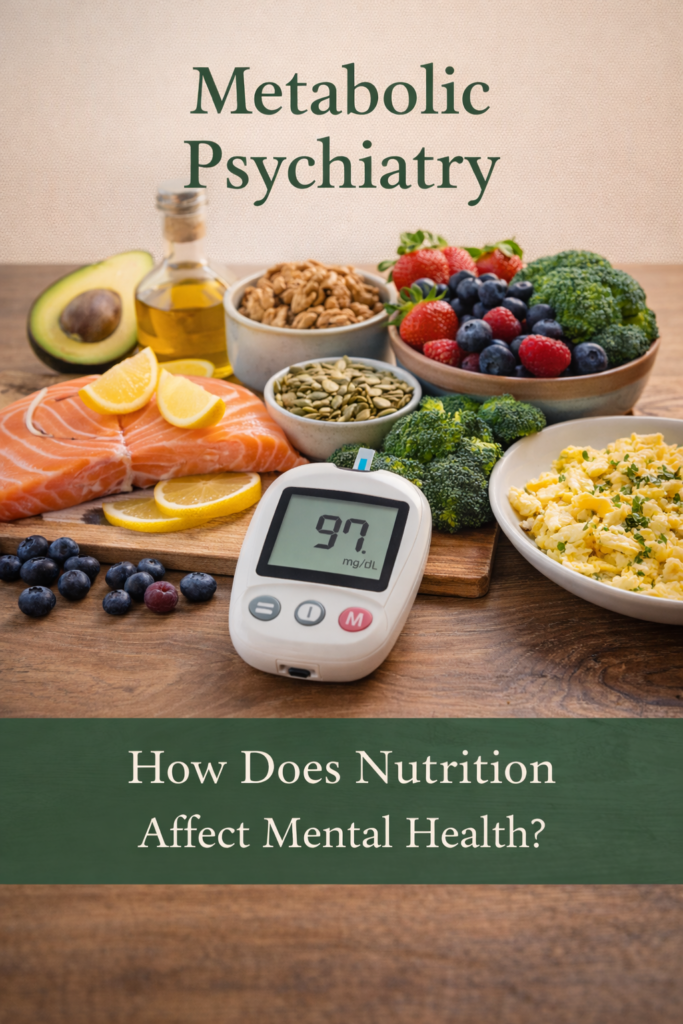
    • Metabolic Psychiatry
    • Weight Management & Binge Eating
  • Services
    • Services
    • Medication Management for Mental Health
    • Telehealth
    • Client-Centered Therapy
    • Metabolic Psychiatry
  • Book An Appointment
  • Contact Us

You Might Not Be Diabetic but You Could Be Insulin Resistant

You Might Not Be Diabetic but You Could Be Insulin Resistant

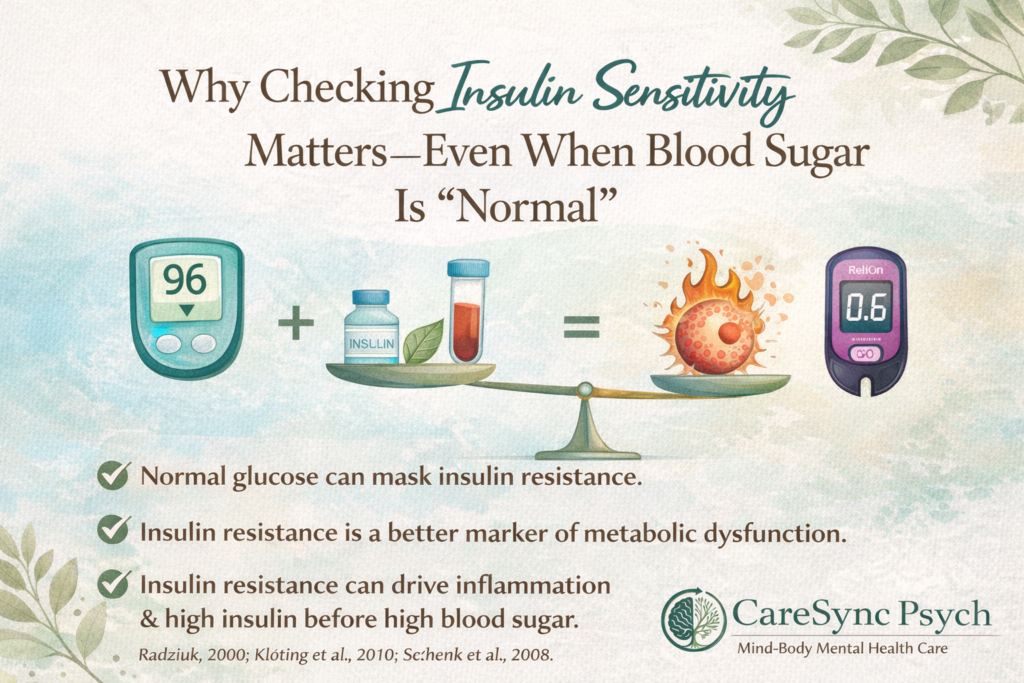
Why Insulin Resistance Matters—Even When Blood Sugar Is “Normal”

You might have insulin resistance even though your glucose levels are normal; this can impact your physical and mental health.

Many people are told their labs are “normal” and assume their metabolic health is fine—especially when fasting glucose falls within the expected range. Yet growing research shows that insulin sensitivity often declines years before blood sugar becomes abnormal. This hidden phase of metabolic dysfunction can quietly affect brain health, mood, energy, weight regulation, and inflammation, long before diabetes ever appears.

At CareSync Psych, we take a mind-body approach to mental health. Understanding insulin sensitivity is a critical part of that picture.

CareSync Psych in Lakeland Florida

-helps patients across Florida understand insulin resistance, metabolic health, and inflammation through metabolic psychiatry. Even with normal blood sugar, impaired insulin sensitivity may drive metabolic dysfunction, obesity, and prediabetes

Insulin Sensitivity vs. Blood Sugar: What’s the Difference?

Insulin Sensitivity vs. Blood Sugar: What’s the Difference?

Glucose is the sugar circulating in your bloodstream.
Insulin is the hormone that helps move glucose from the blood into cells so it can be used for energy.

  • Good insulin sensitivity = cells respond easily to insulin

  • Insulin resistance = cells stop responding well, so the body must release more insulin to keep blood sugar normal

Here’s the key point:
👉 Blood sugar can stay normal for years while insulin levels are chronically elevated.

This is why fasting glucose alone often misses early metabolic dysfunction.

You might have insulin resistance even though your glucose levels are normal; this can impact your physical and mental health.

Many people are told their labs are “normal” and assume their metabolic health is fine—especially when fasting glucose falls within the expected range. Yet growing research shows that insulin sensitivity often declines years before blood sugar becomes abnormal. This hidden phase of metabolic dysfunction can quietly affect brain health, mood, energy, weight regulation, and inflammation, long before diabetes ever appears.

At CareSync Psych, we take a mind-body approach to mental health. Understanding insulin sensitivity is a critical part of that picture.

CareSync Psych in Lakeland Florida helps patients across Florida understand insulin resistance, metabolic health, and inflammation through metabolic psychiatry. Even with normal blood sugar, impaired insulin sensitivity may drive metabolic dysfunction, obesity, and prediabetes (Radziuk, 2000; Schenk et al., 2008).

Insulin Sensitivity vs. Blood Sugar: What’s the Difference?

You might have insulin resistance even though your glucose levels are normal; this can impact your physical and mental health.

At CareSync Psych, we take a mind-body approach to mental health. Understanding insulin sensitivity is a critical part of that picture.

Glucose is the sugar circulating in your bloodstream.
Insulin is the hormone that helps move glucose from the blood into cells so it can be used for energy.

  • Good insulin sensitivity = cells respond easily to insulin

  • Insulin resistance = cells stop responding well, so the body must release more insulin to keep blood sugar normal

Here’s the key point:
👉 Blood sugar can stay normal for years while insulin levels are chronically elevated.

This is why fasting glucose alone often misses early metabolic dysfunction.

Understanding Glucose Metabolism Disorders & Inflammation

Why Insulin Resistance Is a Better Early Marker of Metabolic Health

Research consistently shows that insulin resistance develops first, while glucose abnormalities come later (Radziuk, 2000).

During this stage:

  • The pancreas compensates by producing more insulin

  • Blood sugar appears “normal” on routine labs

  • Inflammation and metabolic stress increase quietly

Why Insulin Resistance Is a Better Early Marker of Metabolic Health

Research consistently shows that insulin resistance develops first, while glucose abnormalities come later (Radziuk, 2000).

During this stage:

  • The pancreas compensates by producing more insulin

  • Blood sugar appears “normal” on routine labs

  • Inflammation and metabolic stress increase quietly

The state of metabolic stress state places strain on multiple systems, including the brain, which is highly sensitive to insulin signaling.

The state of metabolic stress state places strain on multiple systems, including the brain, which is highly sensitive to insulin signaling.

Learn More

“Insulin-Sensitive Obesity” vs. “Hidden Insulin Resistance”

Interestingly, not all metabolic dysfunction looks the same.

Some individuals with higher body weight remain relatively insulin sensitive, while others—often at a “normal” weight—develop insulin resistance (Klöting et al., 2010). This means:

  • Weight alone does not define metabolic health

  • Thin individuals can still have significant insulin resistance

  • Mental health symptoms may appear before physical signs

This is especially relevant in psychiatry, where fatigue, depression, anxiety, brain fog, and poor stress tolerance may have metabolic contributors.

Understanding Glucose Metabolism Disorders & Inflammation

How Insulin Resistance Affects the Brain and Mental Health

Insulin plays a role far beyond blood sugar control. In the brain, insulin signaling supports:

  • Neurotransmitter balance

  • Cognitive function

  • Mood regulation

  • Stress response

When insulin resistance develops, chronic low-grade inflammation increases and brain signaling becomes less efficient (Schenk et al., 2008).

This inflammatory state has been linked to:

  • Depression
  • Anxiety
  • Cognitive slowing
  • Increased stress sensitivity
  • Difficulty regulating appetite and energy
This is one reason metabolic psychiatry looks upstream—before symptoms become entrenched.

Glucose and Neuroinflammation

Why “Normal Labs” Don’t Always Mean Optimal Health

Standard labs often focus on fasting glucose or A1C, which detect problems only after insulin resistance has progressed significantly. Earlier markers may include:

  • Elevated fasting insulin

  • HOMA-IR

  • Triglyceride-to-HDL ratio

  • Signs of systemic inflammation

By the time glucose rises, insulin resistance has often been present for years.

A Metabolic Psychiatry Perspective

At CareSync Psych, we believe mental health care works best when it addresses underlying physiology, not just symptoms. Measuring insulin sensitivity helps us:

  • Identify early metabolic stress

  • Personalize treatment plans

  • Support mood, cognition, and energy more effectively

  • Integrate lifestyle, nutrition, and medical strategies thoughtfully

This approach does not replace psychiatric care—it enhances it by treating the whole person.

What is Metabolic Psychiatry?

CareSync Psych in Lakeland Florida helps patients across Florida understand insulin resistance, metabolic health, and inflammation through metabolic psychiatry.

Even with normal blood sugar, impaired insulin sensitivity may drive metabolic dysfunction, obesity, and prediabetes.

Metabolic Psychiatry

What should you keep in mind?

  • Insulin resistance often appears before blood sugar abnormalities

  • Normal glucose does not guarantee metabolic health

  • Insulin sensitivity is a more sensitive early marker of dysfunction

  • Metabolic health and mental health are deeply interconnected

By identifying these patterns early, we can support long-term mental and physical well-being—before disease develops.

CareSync Psych in Lakeland Florida helps patients across Florida understand insulin resistance, metabolic health, and inflammation through metabolic psychiatry. Even with normal blood sugar, impaired insulin sensitivity may drive metabolic dysfunction, obesity, and prediabetes


Mind-Body Mental Health Care


🌴 Telehealth across Florida
📍 In-person visits in Lakeland, FL
💳 Insurance & Affordable Self-Pay Options


🔗 caresyncpsych.com

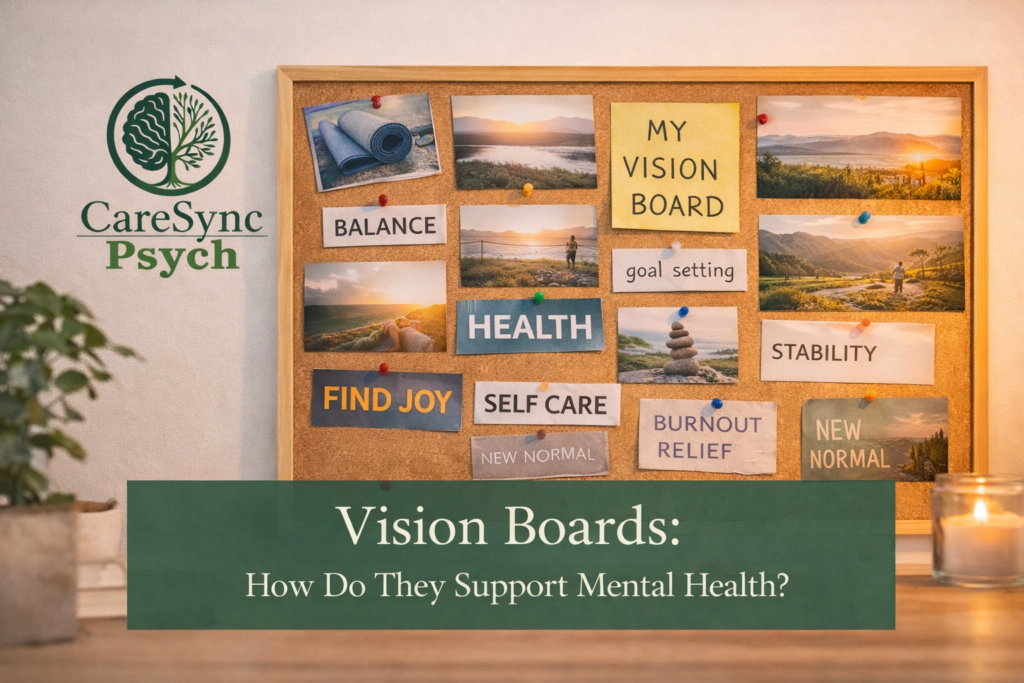
Vision Boards and Mental Health: The Psychology, Science, and How to Make Them Actually Work

Vision Boards and Mental Health: The Psychology, Science, and How to Make Them Actually Work

Vision boards are often dismissed as trendy or superficial—something associated with wishful thinking rather than real psychological change. Yet research in psychology, behavioral science, and therapeutic practice suggests that visualization tools like vision boards can be effective when grounded in intention, reflection, and action.

At CareSync Psych, we take a science-informed approach to tools that support mental health, motivation, and sustainable behavior change. Vision boards are not magic—but when used correctly, they can support clarity, hope, and goal-directed behavior.

Vision boards don’t create change on their own—but they can help you see what you’re working toward.

Home

What Is a Vision Board (Psychologically Speaking)?

A vision board is a visual representation of goals, values, and desired states, typically created using images, words, and symbols that reflect what an individual wants to cultivate in their life.

From a psychological standpoint, vision boards are not about “manifesting” outcomes without effort. Instead, they function as:

  • A self-reflection tool

  • A cognitive priming mechanism

  • A way to externalize goals and values

  • A support for motivation and emotional regulation

Burton and Lent (2016) describe vision boards as a therapeutic intervention that can facilitate insight, emotional processing, and goal clarity—particularly when integrated into structured therapeutic work.


Sometimes, making goals visible is enough to help you move forward.

How to Use Vision Boards Effectively (Without the Hype)

1. Start With Reflection, Not Images

Before creating a vision board, reflect on:

  • What feels missing or misaligned

  • What values matter most right now

  • What kind of life feels supportive—not just impressive

This aligns with PCC’s (2023) framework of moving from reflection to visualization.


2. Focus on Feelings and Values

Include images or words that reflect:

  • Calm

  • Stability

  • Connection

  • Health

  • Balance

Not just achievements or external markers of success.


3. Make Goals Visible—but Grounded

Place your vision board somewhere you’ll see it regularly, but pair it with:

  • Small, realistic goals

  • Flexible timelines

  • Compassion for setbacks

Visibility supports awareness—but action creates change.


4. Use Vision Boards as a Check-In Tool

Revisit your vision board periodically:

  • What still fits?

  • What no longer aligns?

  • What feels unrealistic or pressure-based?

Vision boards should evolve as you do.

Client-Centered Therapy

Vision boards don’t create change on their own—but they can help you see what you’re working toward.

A CareSync Psych Perspective

At CareSync Psych, we view vision boards as one possible tool within a broader mental health and behavior-change framework. When combined with therapy, medication management, lifestyle support, and self-compassion, visualization can help reinforce clarity and direction.

Mental health–informed change is not about forcing positivity.
It’s about supporting the nervous system, reducing overwhelm, and creating environments that make healthy choices easier.

Anxiety Treatment at CareSync Psych

Sometimes, making goals visible is enough to help you move forward.

Final Takeaway

Vision boards work best when they are:

  • Grounded in reflection

  • Paired with action

  • Flexible rather than rigid

  • Used as support—not pressure

You don’t need to manifest a perfect future.
You need clarity, support, and small steps in the right direction.

New Year, New Me? The Psychology of Making Habits Stick

References Used in this Post

Burton, L., & Lent, J. (2016). The use of vision boards as a therapeutic intervention. Journal of Creativity in Mental Health, 11(1), 52–65.

Kharbanda, K. (2025). Exploring the relationship between optimism and hope among individuals using vision boards. International Journal of Interdisciplinary Approaches in Psychology, 3(3), 295–306.

PCC, J. H. (2023). From reflection to visualization: A framework for goal setting and strategic planning. Journal of Financial Planning, 36(12), 44–47.

Read More
Dec 2025 by Jennifer Sanri
New Year, New Me? The Psychology of Making Habits Stick
Read More
Read More
Dec 2025 by Jennifer Sanri
Anxiety Treatment at CareSync Psych
Read More
Read More
Dec 2025 by Jennifer Sanri
When the Holidays Feel Heavy: Understanding Seasonal Sadness

mD

Read More
Read More
Oct 2025 by Jennifer Sanri
Food Addiction: Why It’s Real, Why We Feel Out of Control, and How Healing Begins
Read More

New Year, New Me? The Psychology of Making Habits Stick

New Year, New Me? The Psychology of Making Habits Stick

New Year, New Me? The Psychology of Making Habits Stick

Every January, millions of people set New Year’s resolutions with genuine hope and motivation. Eat healthier. Exercise more. Reduce stress. Improve mental health.

And yet, by February, most resolutions have quietly faded.

This isn’t because people lack discipline or motivation. Science tells us something very different: the way we approach change is often mismatched with how the brain actually forms habits.

Understanding the psychology behind New Year’s resolutions can transform “New Year, New Me” from a cycle of disappointment into sustainable growth.

Why New Year’s Resolutions Often Fail

The idea of a “fresh start” is psychologically powerful. New Years symbolize renewal, identity change, and possibility. However, research shows that good intentions alone are rarely enough to override deeply ingrained habits.

The Intention–Behavior Gap

According to Pope et al. (2014), people frequently intend to make healthier choices in the new year, but real-world behavior often contradicts those goals. Their research on food shopping found that even individuals with strong health intentions continued purchasing the same foods they always had.

Why? Because habits are automatic, not logical.

The brain defaults to familiar routines—especially under stress, time pressure, or emotional fatigue.

Habits Are Not Decisions — They Are Systems

Healthy behavior change doesn’t come from willpower alone. It comes from environmental design, repetition, and emotional regulation.

Maddox and Maddox (2006) emphasized that successful New Year’s resolutions tend to be:

  • Specific rather than vague

  • Gradual rather than extreme

  • Integrated into daily routines

  • Supported by realistic expectations

When resolutions are too broad (“I’ll be healthier”) or too rigid (“I’ll never eat sugar again”), the brain resists them.

The “Res-Illusion” Effect

Pope et al. (2014) coined the idea of New Year’s “res-illusions”—the belief that intention alone will override habit. In reality, behavior is driven by:

  • Convenience

  • Availability

  • Stress levels

  • Emotional states

  • Learned routines

This explains why motivation feels high in January but disappears once life resumes its usual pace.

A Healthier “New Year, New Me” Mindset

Rather than reinventing yourself, psychology suggests a more sustainable approach:
New Year, Same You — With Better Support.

Roberts emphasizes that wellbeing is cultivated through community, self-compassion, and intentional environments, not isolation or perfectionism. Thriving doesn’t come from self-criticism; it comes from systems that support growth.

Insurance & Self-pay Options

How to Make Habits Stick (What Science Supports)

Here are evidence-based strategies to help habits last beyond January.

1. Focus on Identity, Not Outcomes

Instead of “I want to lose weight,” try:
“I am someone who takes care of my body.”

Identity-based habits are more durable.


2. Start Smaller Than You Think

The brain adapts best to small, repeatable actions:

  • 5 minutes of movement

  • One healthier meal per day

  • One consistent bedtime

Consistency beats intensity.

Services

How to Make Habits Stick (What Science Supports)

Here are evidence-based strategies to help habits last beyond January.

1. Focus on Identity, Not Outcomes

Instead of “I want to lose weight,” try:
“I am someone who takes care of my body.”

Identity-based habits are more durable.


2. Start Smaller Than You Think

The brain adapts best to small, repeatable actions:

  • 5 minutes of movement

  • One healthier meal per day

  • One consistent bedtime

Consistency beats intensity.

3. Design Your Environment

Habits are easier when the environment supports them:

  • Healthy foods visible

  • Unhealthy options less accessible

  • Medications placed where you’ll see them

This aligns with findings from Pope et al. (2014) on food purchasing behavior.


4. Expect Setbacks — Plan for Them

Setbacks are not failure; they are part of habit formation. Planning for lapses prevents all-or-nothing thinking.


5. Pair New Habits With Existing Ones

This is called habit stacking:

  • Stretch after brushing teeth

  • Meditate after morning coffee

  • Walk after dinner


6. Regulate Stress First

Chronic stress sabotages habit change. Anxiety, poor sleep, and burnout make consistency harder.

Mental health support improves habit success.


7. Make Goals Measurable and Flexible

Maddox and Maddox (2006) emphasize realistic goal-setting:

  • “Walk 3 days per week” instead of “exercise more”

  • Adjust goals as life changes


8. Focus on Progress, Not Perfection

Perfectionism increases shame and decreases follow-through. Sustainable habits are imperfect by nature.


9. Use Community and Accountability

Roberts highlights the importance of connection and shared values. Habits are more likely to stick when supported by others.


10. Align Habits With Mental Health

Anxiety, depression, and burnout interfere with motivation. Addressing mental health improves energy, focus, and consistency.

Insurance & Self-pay Options

How Mental Health Care Supports Lasting Change

Mental health treatment helps remove barriers to habit formation by addressing:

  • Anxiety and overthinking

  • Emotional eating

  • Low motivation

  • All-or-nothing thinking

  • Shame cycles

At CareSync Psych, we view habit change as a mind–body process, not a willpower test.


A More Compassionate New Year

The most effective New Year’s resolutions are not about becoming someone new. They are about creating conditions that allow you to be well, consistently.

Change sticks when it is:

  • Kind

  • Realistic

  • Supported

  • Flexible

You don’t need a new you.
You need systems that support the you that already exists.

References (APA)

Maddox, R., & Maddox, S. (2006). Healthy New Year’s resolutions. Journal of Modern Pharmacy, 13(1).

Pope, L., Hanks, A. S., Just, D. R., & Wansink, B. (2014). New Year’s res-illusions: Food shopping in the new year competes with healthy intentions. PLOS ONE, 9(12), e110561. https://doi.org/10.1371/journal.pone.0110561

Roberts, E. (n.d.). My New Year’s resolution: Cultivating wellbeing and curating a thriving community.

Read More

Anxiety Treatment at CareSync Psych

Anxiety Treatment at CareSync Psych

Anxiety Disorder Treatment in Florida: Therapy, Medication, and Proven Self-Help Strategies

Anxiety disorders are among the most common mental health conditions in Florida, affecting adults, adolescents, and professionals juggling high stress, family demands, and fast-paced lifestyles. While anxiety can feel overwhelming and persistent, effective treatment is available, and most people improve significantly with the right combination of care.

At CareSync Psych, In Lakeland, Florida , we provide evidence-based anxiety treatment across Florida through medication management, therapy collaboration, and practical self-help strategies designed to calm the nervous system and restore confidence.

Anxiety isn’t a personal failure.

It’s a nervous system stuck in overdrive.

At CareSync Psych, we specialize in treating panic disorder, social anxiety, and OCD with care that goes deeper than symptom checklists or rushed prescriptions.

Panic attacks can make your body feel unsafe.
Social anxiety can quietly shrink your world.
OCD can trap you in exhausting cycles of fear, doubt, and control.

And when these conditions are misunderstood or minimized, the impact can be devastating.

💙 Our approach is different
We combine:


    • Specialized psychiatric care for anxiety and OCD
    • Thoughtful, individualized medication management
    • Therapy-informed treatment planning
    • A nervous-system-focused, mind–body approach

Progress isn’t just “fewer symptoms.”
It’s feeling calmer in your body, more confident in your life, and more in control when anxiety shows up.

 ✨ CareSync Psych helps adults struggling with panic disorder, social anxiety, and OCD regain calm and clarity through personalized, evidence-based psychiatric care.

If anxiety has been running your life—or quietly limiting it—you don’t have to navigate this alone.

CareSync Psych has treatment for anxiety in Lakeland, Florida


Panic disorder feels frightening—but it is treatable.
Anti-anxiety medications, therapy, and self-help strategies can work together to restore calm and confidence.

You don’t have to live in fear of the next panic attack.

Support is available—and recovery is possible.


📍 Anxiety Treatment in Florida | Self-pay & insurance options
📅 Now accepting new patients

Specializing In

How Anxiety Feels in the Body and Mind

Anxiety is not just mental—it is deeply physiological.

People with anxiety often experience:

  • Racing thoughts or constant worry

  • Rapid heart rate or chest tightness

  • Shortness of breath

  • Muscle tension

  • Restlessness or agitation

  • GI discomfort or nausea

  • Fatigue and poor sleep

Many people seek medical care first, believing something is physically wrong—because anxiety can feel that intense.

What Are Anxiety Disorders?

Anxiety disorders involve excessive fear, worry, or nervous system activation that interferes with daily life. Unlike everyday stress, anxiety disorders persist even when no immediate danger is present.

Common anxiety disorders treated in Florida include:

  • Generalized Anxiety Disorder (GAD)

  • Panic Disorder

  • Social Anxiety Disorder

  • Obsessive-Compulsive Disorder (OCD)

  • Health Anxiety

  • Trauma-related anxiety

Understanding Panic Disorder: Breaking the Cycle of Fear

Anxiety Treatment in Florida: Why Medication + Therapy Works Best

Research consistently shows that combining medication with psychotherapy leads to better outcomes than either alone for moderate to severe anxiety.

How Therapy Helps Anxiety

Therapy—especially Cognitive Behavioral Therapy (CBT)—helps by:

  • Teaching how anxiety works

  • Reducing catastrophic thinking

  • Gradually facing feared sensations or situations

  • Building long-term coping skills

Therapy retrains how the brain interprets threat.

Anxiety Treatment in with Anti-Anxiety Medications

Medication can help quiet the nervous system, making therapy and self-help strategies more effective.

Anti-anxiety medications:

  • Reduce baseline anxiety

  • Decrease panic symptoms

  • Improve emotional regulation

Medication Management for Mental Health

Medication is always personalized—there is no one-size-fits-all approach.

Read More

The Psychology of Christmas & Your Mental Health

The Psychology of Christmas & Your Mental Health

Understanding the Psychology of Christmas

Christmas is far more than a holiday on the calendar. Psychologically, it carries deep symbolic meaning, activates powerful emotional memories, and often intensifies mental health experiences—for better and for worse. Research and psychoanalytic perspectives help explain why this season can feel comforting for some and profoundly difficult for others.

More

The Psychology of Christmas: Why This Season Feels So Emotionally Powerful

For many people, Christmas is a time of warmth, connection, and meaning. For others, it can bring stress, sadness, anxiety, or emotional exhaustion. And for many, it’s a mix of both.

Psychology helps explain why Christmas carries such emotional weight — and why struggling during the holidays is far more common than most people realize.

Understanding the psychology of Christmas can help normalize emotional reactions, reduce shame, and guide healthier mental health support during the holiday season.

I am text block. Click edit button to change this text. Lorem ipsum dolor sit amet, consectetur adipiscing elit. Ut elit tellus, luctus nec ullamcorper mattis, pulvinar dapibus leo.

At CareSync Psych, we recognize that Christmas can be meaningful, painful, or both.

The Superego and Holiday Guilt

From a Freudian lens, Christmas can activate unconscious material formed in childhood, including early attachment experiences, unmet needs, and unresolved family dynamics (Freud, 1923).

reud’s concept of the superego — the internalized moral authority shaped by social and parental expectations — is often heightened at Christmas. Cultural messages like “you should be grateful,” “you should be happy,” or “family should come first” can intensify guilt and self-criticism when lived experiences don’t match these ideals.

From a psychoanalytic perspective, holiday distress often reflects increased internal pressure, not personal failure.

Jungian Meaning: Light, Renewal, and the Inner Child

From a Jungian perspective, Christmas is rich in archetypal symbolism (Norris, 2025). It occurs near the winter solstice, representing light emerging from darkness, renewal, and hope.

One of the most powerful symbols associated with Christmas is the Child archetype, which represents:

  • New beginnings

  • Vulnerability

  • Growth and transformation

For some, this symbolism evokes comfort and meaning. For others (especially those with trauma, loss, or disrupted childhood experiences) it can bring grief or emotional pain.

Mental Healthcare in Lakeland, Florida

Why the Holidays Can Feel Emotionally Overwhelming

Christmas can have a powerful psychological impact on mental health. Research suggests that the holiday season often intensifies existing emotional states rather than creating new psychiatric symptoms, a phenomenon sometimes referred to as the “Christmas effect” (Sansone & Sansone, 2011). For many individuals, Christmas heightens reflection, social comparison, and emotional memory retrieval, which may worsen symptoms of anxiety, depression, or loneliness. Understanding the psychology of Christmas helps normalize why mental health symptoms may increase during this time and supports compassionate, stigma-free care.

At CareSync Psych, we recognize that Christmas can be meaningful, painful, or both. Our approach integrates:

  • Psychotherapy for emotional regulation and insight

  • Medication management when appropriate

  • Support for sleep, stress, and routine stabilization

  • A whole-person perspective that honors mind and body

There is no right way to feel during the holidays. Mental health care isn’t about forcing cheer — it’s about supporting authenticity, stability, and well-being.

Psychology of Christmas & Your Mental Health

Christmas functions as a time marker—a moment of reflection, comparison, and emotional evaluation.

According to Sansone & Sansone (2011), the “Christmas effect” refers to the way holidays amplify existing psychological states rather than creating new ones. In other words:

  • Joyful people may feel more joyful

  • Lonely individuals may feel more isolated

  • Those struggling with depression or anxiety may experience symptom intensification

This occurs because Christmas heightens expectations, social comparison, and emotional memory retrieval.

Why the Holidays Can Feel Emotionally Overwhelming

From a psychological perspective, Christmas activates attachment needs, nostalgia, and cultural expectations that may not align with a person’s lived experience. According to Sansone and Sansone (2011), holidays amplify emotional vulnerability by increasing interpersonal demands and self-evaluation. Mulcahy’s work on the psychology of Christmas further emphasizes how unmet expectations and unresolved grief can heighten emotional distress. Recognizing these patterns can reduce self-blame and encourage individuals to seek mental health support during the holidays.

Christmas as a Symbol (Jungian & Psychoanalytic Perspectives)

From Jungian and psychoanalytic perspectives, Christmas carries rich symbolic meaning tied to archetypes such as light emerging from darkness, rebirth, and the inner child (Norris, 2025). These themes can evoke hope, renewal, and connection, but may also resurface unresolved childhood experiences or grief. Psychoanalytic theory suggests that holidays act as psychological mirrors, reflecting unconscious conflicts and emotional needs. This symbolic depth helps explain why Christmas often feels emotionally intense, even in the absence of obvious stressors.

The Deeper Psychological Meaning of Christmas

Christmas can have a powerful psychological impact on mental health. Research shows that the holiday season often intensifies existing emotions, including anxiety, depression, loneliness, and grief. Research suggests that the holiday season often intensifies existing emotional states rather than creating new psychiatric symptoms, a phenomenon sometimes referred to as the “Christmas effect” (Sansone & Sansone, 2011). For many individuals, Christmas heightens reflection, social comparison, and emotional memory retrieval, which may worsen symptoms of anxiety, depression, or loneliness. Understanding the psychology of Christmas helps normalize why mental health symptoms may increase during this time and supports compassionate, stigma-free care. At CareSync Psych, we support individuals navigating holiday stress with compassionate, evidence-based mental health care.

Common Mental Health Challenges During Christmas

Support for Holiday-Related Anxiety and Depression

Mental health treatment during the holidays focuses on stabilization, emotional regulation, and realistic expectations. Therapy and medication management can help reduce anxiety, depressive symptoms, and overwhelm associated with Christmas stress. At CareSync Psych, we offer personalized mental health care that acknowledges the emotional complexity of the holiday season—supporting patients with compassion, validation, and evidence-based treatment.

Mental Health Symptoms During the Holidays

  • Depressive symptoms

  • Anxiety and irritability

  • Sleep disruption

  • Anger
  • Emotional exhaustion

  • Shame
  • Loneliness — even among socially connected individuals

Importantly, research does not show a spike in suicide rates on Christmas Day itself. Instead, emotional distress often increases before and after the holidays, when expectations clash with reality (Sansone & Sansone, 2011).

Why This Matters for Your Mental Health

Understanding the psychology of Christmas helps both clinicians and individuals respond with compassion rather than judgment.

For mental health care, this knowledge allows for:

  • Anticipating seasonal symptom changes

  • Normalizing emotional ambivalence

  • Addressing grief and unresolved attachment wounds

  • Supporting realistic expectations and boundaries

For individuals, it helps reduce shame around “not feeling festive” and encourages seeking support when needed.

At CareSync Psych, we recognize that Christmas can be meaningful, painful, or both. Our approach integrates:

  • Psychotherapy for emotional regulation and insight

  • Medication management when appropriate

  • Support for sleep, stress, and routine stabilization

  • A whole-person perspective that honors mind and body

There is no right way to feel during the holidays. Mental health care isn’t about forcing cheer — it’s about supporting authenticity, stability, and well-being.

How Therapy at CareSync Psych Supports Holiday Mental Health

CareSync Psych Holiday Approach

CareSync Psych’s Approach to Holiday Mental Health

CareSync Psych provides patient-centered mental health care that recognizes the emotional impact of holidays like Christmas. We understand that not everyone experiences the season as joyful. Our approach integrates psychotherapy, medication management, and lifestyle support to help individuals navigate holiday stress, grief, anxiety, and depression. You are not alone—and support is available.

If this season feels heavy, it doesn’t mean you’re failing the holiday.
It often means something important inside you deserves attention and care.

And that awareness can be the first step toward healing.

Christmas is emotionally powerful because it touches something deeply human — our longing for connection, safety, meaning, and renewal.

Sigmund Freud’s Christmas

Sigmund Freud’s Christmas

http://www.caresyncpsych.com

Freud believed that much of human emotional life is shaped by unconscious processes formed in childhood. Christmas, with its rituals, traditions, and emphasis on family, often reawakens early relational dynamics—including unresolved conflicts with caregivers.

Although Sigmund Freud did not write explicitly about Christmas as a holiday, psychoanalytic theory offers a powerful framework for understanding why Christmas can evoke such intense emotional responses—both joyful and distressing.

From a Freudian lens, Christmas is psychologically significant because it activates unconscious conflicts, childhood memories, and internalized expectations rooted in early development.

Psychology of Christmas and the Unconscious

CareSync Psych

Freud believed that much of human emotional life is shaped by unconscious processes formed in childhood. Christmas, with its rituals, traditions, and emphasis on family, often reawakens early relational dynamics—including unresolved conflicts with caregivers.

Key Freudian ideas relevant to Christmas include:

  • Regression:
    Freud described regression as a return to earlier developmental states during times of emotional intensity or stress. Christmas can prompt regression by:
    • Recreating childhood environments
    • Reinforcing dependency needs
    • Evoking longing for safety, care, and unconditional acceptance
    This helps explain why adults may feel unusually vulnerable, emotional, or reactive during the holidays.

Click here for New Year’s Habits


The Pleasure Principle vs. Reality Principle

Freud proposed that human behavior is shaped by tension between:

  • The pleasure principle (desire for gratification, comfort, joy)
  • The reality principle (acceptance of limitations, loss, and imperfection)

Christmas often intensifies this conflict.

Culturally, Christmas promises:

  • Happiness
  • Togetherness
  • Peace
  • Fulfillment

Psychologically, many people experience:

  • Loss
  • Loneliness
  • Family conflict
  • Financial stress

This mismatch can heighten anxiety, guilt, and depressive symptoms, as the psyche struggles to reconcile internal desires with lived reality.

www.caresyncpsych.com


The Superego and Holiday Guilt

Freud’s concept of the superego—the internalized moral authority shaped by parental and societal expectations—is especially active during Christmas.

Holiday messages often reinforce ideas such as:

  • “You should be grateful”
  • “You should be happy”
  • “You should value family”
  • “You should give selflessly”

When internal experiences don’t align with these ideals, individuals may experience:

  • Guilt
  • Shame
  • Self-criticism
  • A sense of personal failure

From a Freudian view, this distress arises not because something is “wrong,” but because the superego is exerting heightened pressure during a culturally moralized season.

Visit CareSync Psych to Learn more or Schedule an Appointment


Childhood, Loss, and the Inner World

Freud emphasized that early childhood experiences form templates for later emotional life. Christmas can activate these templates by highlighting:

  • Absent or idealized caregivers
  • Family ruptures
  • Childhood trauma
  • Unmet dependency needs

For individuals with histories of neglect, loss, or inconsistent caregiving, Christmas may unconsciously reactivate grief—sometimes without clear awareness of why the distress feels so intense.


Defense Mechanisms During the Holidays

Freud described defense mechanisms as unconscious strategies used to manage emotional conflict. Common defenses activated around Christmas include:

  • Denial (“Everything is fine”)
  • Reaction formation (forced cheerfulness)
  • Projection (blaming others for one’s discomfort)
  • Withdrawal (emotional or social disengagement)

Understanding these defenses helps normalize holiday-related behaviors and reduces self-judgment.


Why Freud’s Perspective Still Matters for Mental Health Today

From a modern mental health perspective, Freud’s ideas help explain why Christmas is rarely emotionally neutral. It is a psychologically loaded time—one that brings unconscious material to the surface.

This insight is clinically useful because it:

  • Normalizes emotional intensity during holidays
  • Reduces shame around “not enjoying” Christmas
  • Helps clinicians explore hidden grief or conflict
  • Encourages compassion for oneself and others

Visit CareSync Psych

 CareSync Psych Takeaway

From a Freudian perspective, Christmas is not simply a celebration—it is a psychological mirror. It reflects our earliest relationships, unmet needs, internal conflicts, and desires for comfort and meaning.

If Christmas feels heavy, complicated, or emotionally charged, it doesn’t mean you’re failing the season.
It may mean something important inside you is asking to be seen.

And that awareness can be the beginning of healing.


CareSync Psych’s Approach to Holiday Mental Health

CareSync Psych recognizes that Christmas can be emotionally meaningful, challenging, or both. Research shows that holiday distress is common and psychologically understandable rather than pathological (Sansone & Sansone, 2011). Our approach integrates psychotherapy, medication management, and supportive education to help individuals navigate holiday stress, grief, and anxiety with compassion and evidence-based care.


References


Freud, S. (1923). The ego and the id. Internationaler Psychoanalytischer Verlag.

Freud, S. (1914). On narcissism: An introduction. Standard Edition, 14, 67–102.

Sansone, R. A., & Sansone, L. A. (2011). The Christmas effect on psychopathology. Innovations in Clinical Neuroscience, 8(12), 10–12.

Norris, K. L. (2025). Jungian and psychoanalytic perspectives on Christmas: Origins, motifs, and psychological significances. Taylor & Francis.

Why New Year’s Resolutions Fail—and How to Build Mental Health Habits That Stick

Why New Year’s Resolutions Fail—and How to Build Mental Health Habits That Stick

Every January, people set New Year’s resolutions with the best intentions—only to feel discouraged weeks later when motivation fades. This isn’t a personal failure. Psychology shows that most resolutions fail because they are designed incorrectly, not because people lack willpower.

New research in behavioral psychology explains how to create habits that actually stick, improve mental health, and lead to real, lasting change.


The Psychology Behind New Year’s Resolutions

Research shows that successful resolutions rely on how goals are framed and structured, not how motivated someone feels on January 1st.

A large-scale study by Oscarsson et al. (2020) found that people who set the “right kind” of goals were significantly more successful at maintaining behavior change over time. Similarly, Höchli et al. (2020) demonstrated that resolutions stick when daily habits are connected to deeper personal meaning.


Why Most Resolutions Fail

1. They Focus on What to Avoid

Many resolutions are framed negatively:

  • “Stop being anxious”

  • “Don’t overeat”

  • “Quit procrastinating”

These are called avoidance-oriented goals, and psychology shows they are harder to maintain. The brain responds better when it knows what to move toward, not just what to escape.

2. They Rely on Motivation Instead of Habits

Motivation fluctuates with stress, mood, sleep, and mental health. Habits, on the other hand, become automatic over time. When resolutions depend on constant motivation, they rarely survive real life.

3. They Lack Meaning

When goals are disconnected from personal values, they feel like chores. Without a meaningful “why,” persistence fades quickly.


What the Research Says About Goals That Stick

Approach-Oriented Goals Work Better

According to Oscarsson et al. (2020), people are more successful when goals are framed as actions to build rather than behaviors to eliminate.

Examples of approach-oriented goals:

  • “Build calmer mornings”

  • “Practice mindful eating”

  • “Create a consistent sleep routine”

These goals activate reward pathways in the brain and improve follow-through.


Connect Habits to a Bigger Purpose

Höchli et al. (2020) found that lasting change happens when small daily habits (subordinate goals) support a larger personal purpose (superordinate goals).

Superordinate goal (the why):

  • Better mental clarity

  • Emotional stability

  • Being present for family

  • Feeling healthier in your body

Subordinate habit (the what):

  • Taking medication consistently

  • Practicing a 3-minute breathing exercise

  • Walking for 10 minutes

  • Journaling one sentence at night

When habits serve something meaningful, the brain is more willing to repeat them.


How to Build Mental Health Habits That Last

1. Start Smaller Than You Think

Habits should feel almost “too easy” at first. Small actions repeated consistently are more effective than big changes done inconsistently.

2. Anchor Habits to Existing Routines

Habits stick best when tied to cues you already have:

  • After brushing teeth → brief grounding exercise

  • After coffee → medication check-in

  • Before bed → one-line reflection

3. Focus on Progress, Not Perfection

Psychology shows that self-compassion improves persistence. Missing a day doesn’t erase progress—it’s part of learning.

Book an appointment at CareSync Psych today!


Using Psychology to Become Better—Not Perfect

Psychology doesn’t encourage rigid self-discipline. Instead, it helps you design systems that support you, especially during stress.

Sustainable mental health improvement comes from:

  • Goals aligned with values

  • Habits that fit your real life

  • Compassion during setbacks

  • Consistency over intensity

The goal isn’t to “fix” yourself—it’s to support the version of you you’re becoming.


How CareSync Psych Supports Habit-Based Change

At CareSync Psych, we integrate habit science into psychiatric care, therapy, and metabolic psychiatry. We help patients:

  • Translate goals into realistic daily habits

  • Shift from avoidance-based thinking to approach-oriented growth

  • Reduce mental and metabolic barriers to change

  • building Build routines that support mood, energy, and resilience

  • Stay accountable through structured follow-ups and support

Change works best when it’s supported—not forced.

Services


Final Takeaway

New Year’s resolutions succeed when they are:

  • ✔ Approach-oriented

  • ✔ Habit-based

  • ✔ Meaning-driven

  • ✔ Compassionate

  • ✔ Sustainable

Psychology doesn’t ask you to try harder—it teaches you to try smarter.


Looking to build habits that support your mental health this year?

Contact CareSync Psych to learn how evidence-based psychiatry, therapy, and metabolic support can help you create lasting change.

About Us

Social Anxiety

Social Anxiety

Why Social Anxiety Flares During the Holidays: What the Research Tells Us

http://www.caresyncpsych.com

The holiday season is painted as a time of warmth, gatherings, and joyful connection. But for people living with social anxiety disorder (SAD), this time of year can feel especially overwhelming. Increased social expectations, crowded environments, and pressure to perform emotionally often collide with the core symptoms of social anxiety—leaving many feeling drained, ashamed, or even fearful.

Two major research findings help us understand why the holidays can be such a triggering time.


1. Shame Deepens Social Anxiety

Swee, Hudson, & Heimberg (2021) found that shame plays a powerful role in the experience of social anxiety—more than many people realize. Shame fuels the belief that “there’s something wrong with me” or “I’m not good enough,” making social interactions feel threatening.

During the holidays, shame can intensify because:

  • There are more opportunities for comparison

  • Family gatherings may resurface old insecurities

  • People feel pressure to appear happy or confident

  • Comments about appearance, lifestyle, or achievements can sting

Shame becomes a lens that distorts interactions. A small awkward moment—forgetting someone’s name, stumbling over words, or feeling out of place—can spiral into deep self-criticism. This emotional layer makes holiday events feel less like celebrations and more like tests.

http://www.caresyncpsych.com


2. Social Anxiety Changes How the Brain Processes Faces

One of the most striking insights from Günther et al. (2021) is that people with social anxiety perceive and process emotional faces differently. Eye-tracking studies show that individuals with SAD often:

  • avoid looking directly at faces

  • especially avoid eyes

  • hyper-focus on negative or threatening expressions

  • interpret neutral expressions as negative

  • scan their environment for signs of rejection or disapproval

Imagine walking into a holiday party with these heightened patterns. Every glance feels loaded. Neutral faces appear judgmental. Your brain is working overtime, trying to detect threat in a room full of people who may not be thinking about you at all.

This hypervigilance is exhausting—and it’s a big reason holiday gatherings feel so intense.


3. The Holiday Environment Amplifies These Vulnerabilities

When shame and hyper-attuned threat perception collide with holiday expectations, people with social anxiety experience:

• Fear of judgment

Everything—from how you look in photos to what you bring to the potluck—can feel like it’s being evaluated.

• Anticipatory anxiety

Worrying for days or weeks before family gatherings or work parties.

• Rumination after events

Replaying conversations and perceived mistakes long after everyone else has moved on.

• Physical symptoms

Racing heart, sweating, trembling, nausea, or feeling frozen when entering crowded spaces.

• Social exhaustion

Because the brain never turns off its “threat scanning” mode, social events drain energy quickly.

http://www.caresyncpsych.com


4. You’re Not Alone—And Your Experience Is Valid

If holiday gatherings make you feel tense, self-conscious, or overwhelmed, you’re not “being dramatic.” You’re responding to an environment that intensifies patterns already linked to social anxiety.

The research affirms what many people feel but can’t always explain:
Your brain processes social cues differently—and that’s why this season may feel harder for you.


5. How CareSync Psych Supports You Through the Season

Whether you’re navigating mild social discomfort or living with significant social anxiety, support is available:

  • Evidence-based therapy (CBT, exposure therapy, mindfulness-based approaches)

  • Medication management when needed

  • Coaching on boundaries, pacing, and communication

  • Skills for managing shame and reducing self-criticism

  • Strategies for recovering emotionally after social events

You don’t have to push yourself past your limits—or avoid everything altogether. There is a middle ground, and we can help you find it.

www.caresyncpsych.com

When the Holidays Feel Heavy: Understanding Seasonal Sadness

mD

When the Holidays Feel Heavy: Understanding Seasonal Sadness

The winter holidays are often described as magical—glowing lights, family gatherings, celebrations, and traditions that fill the season with joy. But as Kamerlin (2024) reminds us, this time of year can also bring complicated emotions. For many people, the holidays are not cheerful—they’re overwhelming, exhausting, or even painful.

If you’re struggling, you’re not alone. And nothing is “wrong” with you for feeling this way.

Why the Holidays Can Trigger Depression

1. The Pressure to Be Happy

Holidays come with a cultural script: smile, celebrate, feel grateful. Kamerlin (2024) highlights how this pressure can turn normal stress or sadness into something heavier. When everyone else seems joyful, people often hide their struggles—leading to isolation, shame, and emotional exhaustion.

2. Emotional Overload

Even positive events can be overwhelming. Preparing, hosting, traveling, managing finances, or navigating family dynamics can stretch anyone past their capacity. For those already coping with anxiety, trauma, chronic stress, or mental health conditions, the intensity of the season can amplify symptoms.

3. Grief Feels Sharper This Time of Year

The holidays tend to spotlight who is missing. Empty chairs at the table. Memories tied to traditions. Even if time has passed, grief often resurfaces—quietly, powerfully, unexpectedly.

4. Family Conflict and Relationship Stress

While some families gather with warmth, others gather with tension. Old wounds, unresolved conflict, or strained relationships may surface, and coping with these emotions can be draining.

5. Financial Strain

Gift-giving expectations, travel costs, and holiday events add financial pressure. Stress around money can quickly spiral into feelings of failure or hopelessness, especially in a season built around giving.

6. Loneliness in a Season of Togetherness

Kamerlin (2024) emphasizes an overlooked truth: many people enter the holidays feeling alone—physically, emotionally, or both. Social media only magnifies this, making everyone else’s life look picture-perfect.

7. Disruption of Routines

Sleep changes, irregular meals, altered schedules, travel, and overstimulation can destabilize mental health—especially for individuals with anxiety, depression, bipolar disorder, or OCD. Structure matters, and the holidays often remove it.


You’re Allowed to Feel What You Feel

The holidays don’t have to be perfect. They don’t have to be happy. And they don’t have to look like anyone else’s.

If this season feels heavy, give yourself permission to:

  • Take breaks

  • Set boundaries

  • Say “no” without guilt

  • Ask for help

  • Create new traditions that feel safe

  • Let go of expectations that don’t serve you

Your emotional experience is valid—even if it doesn’t match the holiday music or TV commercials.


Support Is Available

If the holiday season brings up sadness, anxiety, grief, or overwhelm, CareSync Psych is here to support you through it. Whether you need therapy, medication management, stress-reduction strategies, or a safe space to talk, you don’t have to face this season alone.

Compassion, understanding, and healing are possible—even in the middle of winter.

Is It Depression—Or Are You Low on Vitamin D? What You Need to Know

Is It Depression—Or Are You Low on Vitamin D? What You Need to Know

Is It Depression—Or Are You Low on Vitamin D? What You Need to Know

Is It Depression—Or Are You Low on Vitamin D? What You Need to Know

Visit CareSync Psych

When you’re feeling down, exhausted, or emotionally flat, it’s easy to assume it’s “just depression.” But your mood is deeply connected to your body—and sometimes, symptoms of depression overlap with nutrient deficiencies that are surprisingly common.

One of the most overlooked contributors is low vitamin D.

Research over the past decade has consistently shown a strong link between vitamin D deficiency and depressive symptoms, making it an important piece of the mental health puzzle.

Vitamin D and Depression: What the Research Shows

Visit CareSync Psych

According to Milaneschi et al. (2014), and other large population studies,—found that individuals with depressive disorders often have significantly lower vitamin D levels. This association holds true across ages, genders, and geographic locations.

Vitamin D Plays a Biological Role in Mood Regulation

Vitamin D is not just a nutrient,  it acts more like a hormone. According to Menon et al. (2020), vitamin D receptors are found in brain regions responsible for mood, emotional regulation, and cognitive functioning. When vitamin D levels drop, these brain systems may not work as effectively.

Visit CareSync Psych

Vitamin D Can Influence Key Neurotransmitters

Visit CareSync Psych

Vitamin D has been shown to affect:

  • Serotonin production

  • Dopamine regulation

  • Inflammation pathways

These are the same pathways involved in depression, suggesting that vitamin D deficiency can contribute to symptoms—or worsen an existing depressive disorder.

Why Low Vitamin D Can Make You Feel Depressed

Vitamin D deficiency can create both emotional and physical symptoms that look—and feel—like depression.

Emotional/Mood Symptoms

  • Low mood

  • Irritability

  • Increased anxiety

  • Lack of motivation

  • Feeling “blah” or emotionally numb

Physical Symptoms That Can Be Misinterpreted as Depression

  • Fatigue

  • Muscle aches

  • Brain fog

  • Low energy

  • Sleep disturbances

  • Slow recovery from illness
When these physical symptoms happen alongside emotional ones, it’s natural to assume the cause is purely psychological. But sometimes the body is signaling a deeper imbalance.
Visit CareSync Psych

Who Is Most at Risk of Vitamin D Deficiency?

You may be more vulnerable if you:

  • Spend most of your time indoors

  • Wear sunscreen or protective clothing often

  • Live in northern or low-sunlight areas

  • Have darker skin tones

  • Are overweight

  • Are pregnant or postpartum

  • Have autoimmune conditions

  • Experience chronic pain or inflammation
Understanding your risk can help you take proactive steps toward better health.

Why You Should Consider Checking Your Vitamin D Levels

If you’re experiencing depressive symptoms—or if your mood seems to change with the seasons—testing your vitamin D levels can give you valuable information.

It’s a simple blood test, and it may reveal a deficiency that’s contributing to how you feel. While vitamin D is not a replacement for therapy or medication, restoring normal levels may:

  • Improve mood stability

  • Reduce fatigue

  • Support better sleep

  • Decrease inflammation

  • Enhance overall mental well-being

Think of it as one more tool in a holistic, whole-body approach to mental health.

Talk with your provider about your vitamin D levels, and ask if your levels need to be checked.

CareSync Psych Can Help You Understand the Full Picture

At CareSync Psych, we look beyond symptoms—we look at you as a whole person. If you’re struggling with low mood, exhaustion, or emotional changes, we can help you determine whether vitamin D deficiency might be part of the issue.

Our team can:

  • Order vitamin D testing

  • Interpret your results

  • Create a tailored plan that may include supplementation, therapy, lifestyle changes, or medication management

When your mind and body work together, healing becomes more powerful.

Visit CareSync Psych
  • Prev
  • 1
  • 2
  • 3
  • 4
  • Next

We are an outpatient mental health care provider committed to integrating evidence-based treatment with a holistic, healing-centered approach to promote mental wellness. Our patient-focused services include medication management, psychotherapy, metabolic psychiatry,  and wellness optimization.

“Providing compassionate mental health care by syncing the mind and body—treating the psychological with the physiological.”

Recent Posts

  • How Nature Supports Mental Health and Stress Reduction | CareSync Psych
  • The Power of the Unconscious | Mental Health Growth and Self-Awareness | CareSync Psych
  • Group Psychology Can Change Society
  • Why Propranolol Is One of My Favorite Medications in Psychiatry
  • Evidence Over Fear: Understanding Antidepressant Withdrawal
  • Home
  • About Us
  • Services
  • Book An Appointment
  • Contact Us
  • Weight Loss Management & Control
  • Immunity & Mental Health
  • Food Addiction & Binge Eating
  • Free Mental Health Worksheets to Download

Copyright ©2026 all rights reserved
CareSync™ Health