
What Happens in the Brain During Panic? | CareSync Psych
Research continues to improve our understanding of why panic occurs and how recovery happens
The Biology of Panic Disorder: What Happens in the Brain During Panic? | CareSync Psych
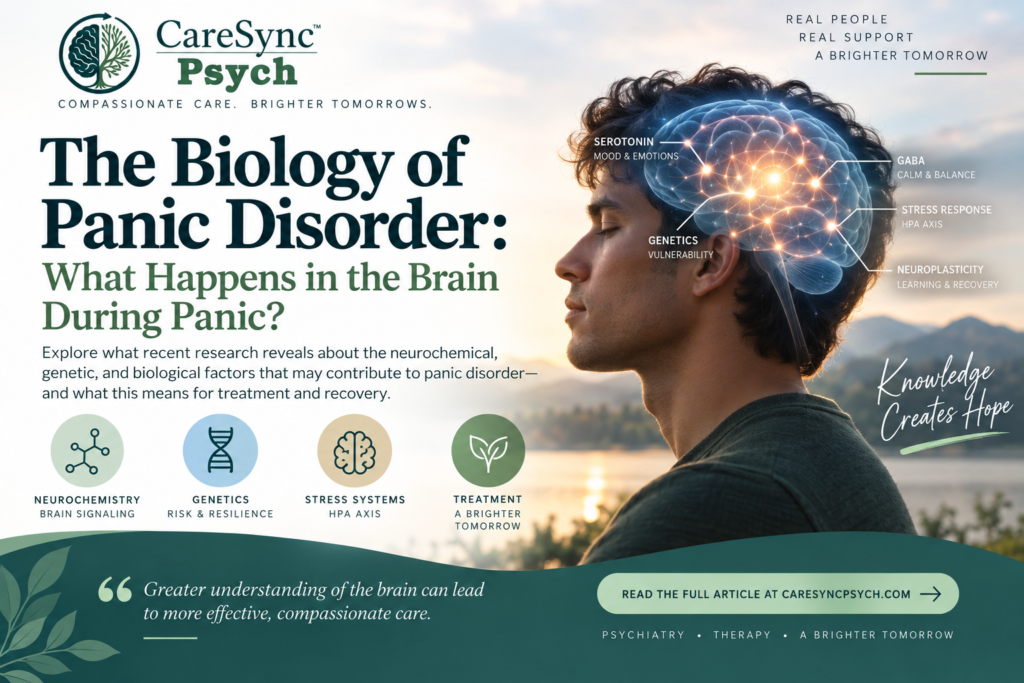
The Biology of Panic Disorder: What Happens in the Brain During Panic?
A panic attack can feel as though your body suddenly decides that you are in danger—even when no obvious threat is present. Research is helping us understand why. Panic disorder appears to involve a complex interaction between the brain's fear circuitry, neurotransmitters, stress-response systems, genetics, and environmental experiences.
Panic Is More Than "Just Anxiety"
Anyone who has experienced a severe panic attack knows that the symptoms can feel intensely physical.
Your heart may race. Your breathing may change. You may become dizzy, shaky, nauseated, sweaty, or lightheaded. Some people experience chest pressure, tingling, derealization, or a frightening sense that they are losing control.
These experiences are real physiological responses. The important distinction is that the body's alarm system may be activating when the situation itself does not require an emergency response.
It involves interactions among brain circuits responsible for detecting threat, regulating arousal, interpreting physical sensations, and returning the nervous system to baseline.
What Does Recent Research Tell Us?
A 2024 systematic review published in Translational Psychiatry examined neurochemical, genetic, and epigenetic research related to panic disorder.
Moraes and colleagues reviewed 33 original studies examining biological mechanisms potentially involved in panic disorder. Their findings highlighted several interacting systems rather than identifying one single chemical, gene, or brain region responsible for panic.
The research points toward a network involving neurotransmission, stress-response pathways, neuroplasticity, brain metabolism, genetic variation, and fear-processing circuits.
Your Brain Has a Built-In Alarm System
Fear is not inherently unhealthy. It is one of the body's most important survival mechanisms.
When the brain perceives danger, interconnected regions rapidly coordinate physical and behavioral responses designed to protect us. Areas involved in this broader fear network include the amygdala, hypothalamus, hippocampus, insula, prefrontal cortex, and periaqueductal gray.
The problem in panic disorder may not be the existence of this alarm system—but how easily it activates and how the brain interprets the signals it generates.
The Chemical Messengers Involved in Panic
There is no single "panic chemical." Instead, several neurotransmitter and signaling systems appear to interact within the brain's fear and arousal networks.
GABA
Gamma-aminobutyric acid, or GABA, is one of the brain's primary inhibitory neurotransmitters. One way to think about GABA is as part of the brain's braking system.
Research has identified differences involving GABA-related signaling in panic disorder, including findings involving GABA-A receptors.
Serotonin
Serotonin participates in mood regulation, anxiety, sleep, and the processing of threatening information.
Differences involving serotonin receptors and signaling have been investigated as part of the biological framework of panic disorder.
Norepinephrine
Norepinephrine helps regulate alertness and the body's response to potential threats.
Excessive activation of arousal systems can contribute to symptoms such as increased heart rate, trembling, sweating, and heightened vigilance.
Glutamate
Glutamate is the brain's major excitatory neurotransmitter and plays an important role in neural communication and learning.
Research has identified differences involving glutamate and brain metabolism in people with panic disorder, although the clinical significance continues to be investigated.
Orexin: Connecting Arousal, Wakefulness & Panic
Another interesting area of research involves orexin, also called hypocretin.
Orexin is a signaling system involved in wakefulness, arousal, motivation, and the body's response to stress.
The Moraes review discusses experimental evidence suggesting that orexin-producing neurons within portions of the hypothalamus may participate in panic-like responses.
This does not mean that orexin is "the cause" of panic disorder. Instead, it illustrates how panic may emerge from multiple overlapping systems responsible for keeping us alert and prepared to respond to danger.
The Stress Response: The HPA Axis
The hypothalamic-pituitary-adrenal, or HPA axis, is one of the body's major stress-response systems.
When the brain perceives a threat, this system helps coordinate the release of hormones involved in preparing the body to respond. Cortisol is one of the best-known hormones associated with this pathway.
Researchers continue to investigate whether alterations in this stress-response network contribute to increased vulnerability to panic and other anxiety disorders.
Neuroplasticity: How the Brain Learns Fear—and Safety
Another area highlighted in the research involves brain-derived neurotrophic factor (BDNF).
BDNF participates in neuroplasticity—the brain's ability to modify connections and adapt through experience.
This matters because panic disorder involves learning.
After a frightening panic attack, the brain may begin associating certain physical sensations, locations, activities, or situations with danger.
For example, someone who experienced panic while driving may begin to fear driving itself. Someone who became panicked after noticing a rapid heartbeat may eventually become frightened whenever their heart rate increases—even during normal exercise.
Fortunately, neuroplasticity also allows the brain to learn something new: these sensations can be uncomfortable without necessarily being dangerous.
Is Panic Disorder Genetic?
Genetics appear to contribute to vulnerability to panic disorder, but the answer is considerably more complicated than inheriting a single "panic gene."
Researchers have investigated genetic variations affecting several systems involved in fear, stress, and neurotransmission.
The 2024 review discusses research involving genes such as NPSR1, HTR1A, and SLC6A2, among others.
These findings do not mean that carrying a particular genetic variant guarantees that someone will develop panic disorder.
Mental health conditions typically develop through interactions among biology, psychological experiences, stress, environment, learning, medical factors, and other influences.
What Is Epigenetics?
Your DNA sequence is not the entire story.
Epigenetics examines biological processes that influence how genes are expressed without changing the underlying DNA sequence itself.
Environmental experiences—including chronic stress—may influence some of these regulatory processes.
Researchers are investigating whether epigenetic changes within stress and fear pathways could help explain why genetic vulnerability leads to panic disorder in some individuals but not others.
This remains an evolving area of research and is not currently a routine diagnostic test for panic disorder.
What About Inflammation?
The review also identified preliminary findings involving inflammatory and metabolic markers, including interleukin-6 (IL-6) and leptin.
This is particularly interesting because modern psychiatric research increasingly examines communication between the brain and the rest of the body.
However, these findings should not be interpreted to mean that inflammation alone causes panic disorder or that routine inflammatory testing can diagnose panic disorder.
More research is needed to understand whether these biomarkers are causal, consequential, or simply associated with other biological processes occurring in panic disorder.
So Is Panic Disorder Biological or Psychological?
That question creates a false choice.
Modern mental health care increasingly recognizes that psychological and biological processes continuously interact.
Biology Matters
Genetics, neurotransmitters, stress hormones, neural circuits, sleep, medical conditions, and other physiological factors may influence vulnerability.
Learning Matters
The brain learns associations between sensations, environments, thoughts, and perceived danger.
Environment Matters
Stress, trauma, relationships, work, health, substances, and life experiences can influence symptoms.
Behavior Matters
Avoidance and safety behaviors can unintentionally reinforce the brain's expectation that certain sensations or situations are dangerous.
What Does This Mean for Treatment?
Understanding the biology of panic disorder does not mean that treatment must target every biological pathway identified in laboratory research. Many of these mechanisms remain under investigation.
Current treatment instead focuses on interventions with established clinical evidence while continuing to incorporate new research as the science evolves.
Psychotherapy
Psychotherapy—particularly cognitive behavioral approaches—can help patients understand panic symptoms, identify patterns that maintain fear, reduce avoidance, and gradually develop greater tolerance of anxiety-related sensations.
Learn more about psychotherapy at CareSync Psych .
Medication Management
Medication can be appropriate for some individuals with panic disorder. Treatment decisions should consider symptom severity, medical history, other medications, previous treatment response, co-occurring psychiatric conditions, side effects, and patient preferences.
Whole-Person Assessment
Symptoms that resemble panic can sometimes occur with medical conditions, medications, substances, sleep disruption, or other psychiatric conditions. A comprehensive evaluation can help determine whether additional assessment is appropriate.
Explore the conditions and areas of focus treated at CareSync Psych .
The Takeaway
Research increasingly shows that panic disorder cannot be reduced to a single chemical imbalance or one malfunctioning part of the brain.
Instead, panic appears to emerge from interactions among fear circuitry, neurotransmitters, stress-response systems, neuroplasticity, genetics, epigenetics, learning, and environmental experiences.
The same nervous system capable of learning fear is also capable of learning safety, developing new responses, and recovering with appropriate treatment.
Continue Learning About Mental Health
Explore additional CareSync Psych services and mental health resources:
When Panic Starts Controlling Your Life, It's Time to Understand Why
If panic attacks, persistent anxiety, fear of another attack, or avoidance are interfering with work, school, relationships, driving, travel, sleep, or everyday activities, an evaluation can help determine what may be contributing to your symptoms and what treatment options are available.
CareSync Psych provides psychiatric evaluation, medication management, psychotherapy, and individualized mental health treatment.
Moraes, A. C. N., Wijaya, C., Freire, R., Quagliato, L. A., Nardi, A. E., & Kyriakoulis, P. (2024). Neurochemical and genetic factors in panic disorder: A systematic review. Translational Psychiatry, 14(1), 294.
DOI: 10.1038/s41398-024-02966-0
Medical Disclaimer: This article is provided for educational purposes and is not intended to diagnose, treat, or replace individualized medical or psychiatric care. Research findings involving genetics, neurotransmitters, inflammation, or other biomarkers should not be interpreted as diagnostic tests for panic disorder.
Symptoms associated with panic attacks can overlap with medical conditions. New or unexplained chest pain, fainting, significant difficulty breathing, new neurological symptoms, or other concerning physical symptoms should receive appropriate medical evaluation.
CareSync Psych is not a crisis center. If you are experiencing a psychiatric or medical emergency, call 911 or go to the nearest emergency department. The 988 Suicide & Crisis Lifeline is available by calling or texting 988.