
In today’s world, people are more connected digitally than at any other point in history—yet many individuals feel increasingly anxious, polarized, isolated, and emotionally overwhelmed.
Two influential works that explore these dynamics are:
The Psychology of Totalitarianism by Mattias Desmet and Group Psychology and the Analysis of the Ego by Sigmund Freud.
Although written generations apart, both books explore an important psychological question:
At CareSync Psych, we believe psychological insight can empower individuals to better understand themselves, their relationships, and the world around them.
How does group influence shape individual thinking, emotions, identity, and behavior?
The Human Need for Belonging
Humans are social beings. We naturally seek:
- Connection
- Meaning
- Identity
- Safety
- Community
When people feel disconnected, fearful, uncertain, or emotionally distressed, group dynamics can become incredibly powerful.
Freud discussed how individuals in groups may unconsciously shift parts of their identity toward the group itself, sometimes leading emotions and collective thinking to overpower individual reasoning.
Desmet expands on this concept by exploring how fear, chronic stress, loneliness, uncertainty, and social fragmentation may increase susceptibility to rigid collective thinking and emotional contagion.
Mental health does not exist in isolation from society.
When individuals are chronically stressed, isolated, sleep-deprived, overstimulated, or emotionally dysregulated, they may become more vulnerable to external emotional influence and black-and-white thinking.
Chronic stress, fear, social division, and constant exposure to emotionally charged information can affect:
- Anxiety levels
- Emotional regulation
- Critical thinking
- Relationships
- Sense of identity
- Nervous system activation
Many people today report feeling:
- Emotionally exhausted
- Hypervigilant
- Disconnected
- Angry or fearful
- Overstimulated by media and social conflict
Understanding group psychology can help individuals become more aware of:
✔ Emotional influence
✔ Cognitive bias
✔ Fear-based thinking
✔ Social pressure
✔ Identity and belonging needs
✔ The impact of chronic societal stress on mental health
At CareSync Psych, we believe psychological insight can empower individuals to better understand themselves, their relationships, and the world around them.
Awareness Is Protective
Awareness can help people:
- Pause before reacting emotionally
- Think more independently
- Build healthier relationships
- Reduce black-and-white thinking
- Stay grounded during uncertainty
- Strengthen emotional resilience
Mental wellness includes not only caring for ourselves individually, but also understanding the environments and systems that influence how we think, feel, and relate to others.
When emotions run high in groups, people may:
- React impulsively
- Adopt beliefs without reflection
- Feel pressured to conform
- Seek safety in certainty
- Lose connection with their individual emotional awareness
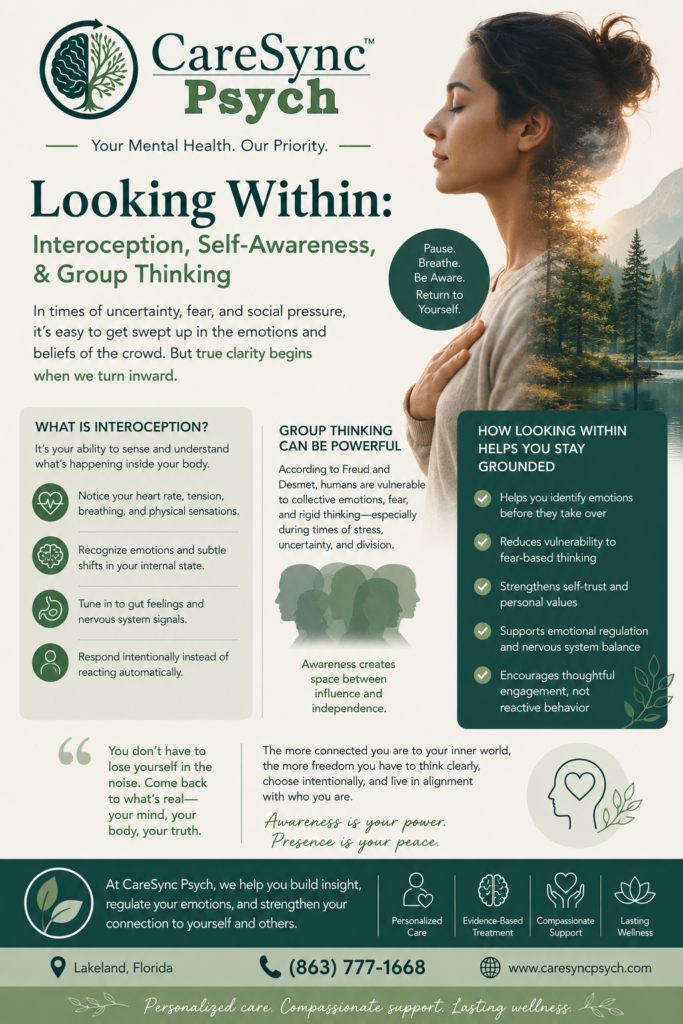
This is where introspection and interoception become deeply important.
The ability to ask ourselves:
- “What am I actually feeling right now?”
- “Is this fear mine, or am I absorbing collective fear?”
- “Am I reacting emotionally or thoughtfully?”
- “What is happening in my body as I consume this information?”
- “Am I grounded, or emotionally overwhelmed?”
can create space between emotional contagion and conscious decision-making.