
what it really means
Precision Psychiatry & Personalized Mental Health Care | CareSync Psych
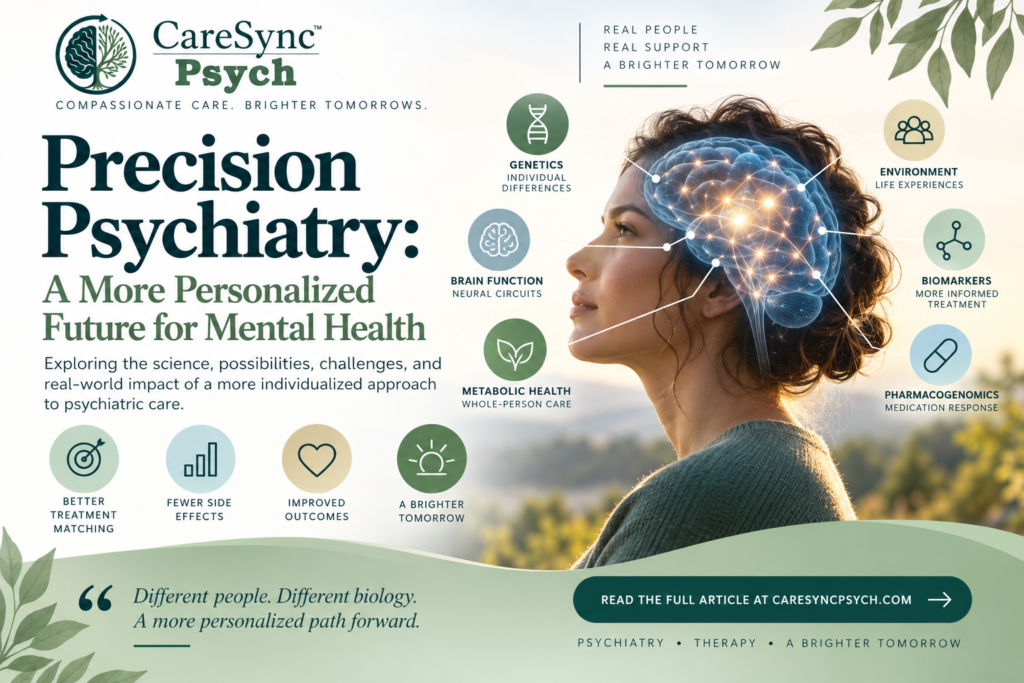
Precision Psychiatry: Can Mental Health Treatment Become More Personalized?
What if psychiatric treatment could move beyond asking only, "What usually works for people with this diagnosis?" and increasingly ask, "What is most likely to work for this particular person?"
That is the promise of precision psychiatry—but the science is more complex, and more interesting, than simply taking a genetic test.
Why Psychiatry Is Moving Toward Greater Precision
Two people can meet criteria for the same psychiatric diagnosis and have remarkably different experiences.
Two patients diagnosed with major depressive disorder, for example, may differ in sleep, appetite, cognition, anxiety, inflammation, trauma exposure, metabolic health, genetics, brain circuitry, medication response, side effects, and functional impairment.
Yet our current diagnostic systems primarily organize psychiatric conditions according to clusters of symptoms.
Those systems remain extremely useful. They give patients, clinicians, researchers, insurers, and health systems a shared language.
But a diagnosis does not necessarily tell us exactly why a particular person's symptoms developed—or which treatment that individual will respond to best.
Can we combine clinical symptoms with biological, behavioral, environmental, and other measurable information to make psychiatric diagnosis and treatment more individualized?
What Is Precision Psychiatry?
Precision psychiatry is an emerging approach that aims to use individual differences to improve how mental health conditions are understood, classified, prevented, and treated.
Rather than relying exclusively on diagnostic labels, researchers are investigating whether multiple types of information can help identify clinically meaningful subgroups and predict treatment response.
Symptoms & Clinical History
Mood patterns, anxiety, cognition, sleep, psychosis, trauma, substance use, previous treatment response, side effects, medical history, and functional impairment remain essential.
Genetics
Genetic variation may influence vulnerability to illness as well as how some medications are metabolized or tolerated.
Brain Function
Researchers are studying neuroimaging, EEG, neural circuitry, and other measures of brain function as potential biomarkers.
Metabolic & Biological Health
Metabolism, inflammatory signaling, hormones, sleep, cardiovascular health, and other physiological systems may provide clinically useful information in selected circumstances.
Environment & Experience
Trauma, chronic stress, relationships, socioeconomic factors, lifestyle, substance exposure, and other environmental influences interact with biology.
Digital & Behavioral Data
Future models may incorporate carefully validated information from sleep tracking, activity, cognitive testing, symptom monitoring, speech, or other behavioral measurements.
Isn't This Just Personalized Psychiatry?
There is substantial overlap, but the terms are not exactly identical.
Good psychiatric care has always been personalized. Clinicians already consider age, symptoms, medical history, family history, previous medications, treatment preferences, pregnancy considerations, substance use, side effects, lifestyle, and many other factors.
Precision psychiatry attempts to add validated predictive information to that clinical judgment.
The long-term goal is not merely to personalize the conversation. It is to improve our ability to predict which intervention is most appropriate for which patient.
Precision Psychiatry vs. Stratified Psychiatry
An important distinction in the research literature is between precision psychiatry and stratified psychiatry.
True precision psychiatry might eventually create highly individualized models incorporating numerous biological and clinical characteristics.
Stratified psychiatry takes a more immediately practical approach: identify subgroups of patients who share a measurable characteristic that predicts response to an existing treatment.
"What treatment works for depression?"
researchers might ask:
"Which subgroup of patients with depression is most likely to benefit from this particular treatment?"
This may represent one of the more realistic near-term paths toward greater precision in everyday psychiatric practice.
Pharmacogenomics: One Piece of Precision Psychiatry
Pharmacogenomics—or PGx—is probably the precision psychiatry tool patients encounter most often today.
Pharmacogenomic testing examines genetic variants that may affect how the body processes or responds to certain medications.
Some of the strongest psychiatric pharmacogenomic evidence involves drug-metabolizing enzymes such as:
- CYP2D6
- CYP2C19
- CYP2B6
Certain HLA variants also have important implications for specific medication-related adverse reactions.
What Pharmacogenomics Can Potentially Tell Us
For selected medications, genetic information may help clinicians understand whether someone is likely to metabolize a medication more slowly or rapidly than expected and whether dosing modifications or alternative medications should be considered.
What It Cannot Reliably Tell Us
A pharmacogenomic test generally cannot look at a list of psychiatric medications and definitively identify:
- the medication that will work best;
- whether a medication will completely relieve symptoms;
- whether someone has depression, bipolar disorder, ADHD, or another diagnosis;
- whether psychotherapy will work;
- the complete likelihood of side effects; or
- the biological "cause" of a person's psychiatric symptoms.
Precision Psychiatry: What Is Real Today and What Is Still Emerging?
More Clinically Established
- Detailed clinical phenotyping
- Medication-response history
- Selected pharmacogenomic drug-gene relationships
- Therapeutic drug monitoring for appropriate medications
- Relevant laboratory and medical evaluation
- Measurement-based psychiatric care
- Individualized risk-benefit assessment
Promising but Still Developing
- Routine psychiatric diagnosis from brain scans
- AI selecting a perfect medication from biomarkers
- Blood tests that definitively diagnose most psychiatric disorders
- Routine inflammatory subtyping of psychiatric illness
- Whole-genome prediction of psychiatric treatment response
- Digital biomarkers used independently to diagnose illness
- Completely individualized brain-circuit treatment for routine care
Brain Circuits May Change How We Think About Diagnosis
Psychiatric diagnoses are currently defined largely by symptoms, but different symptoms may arise from disruptions in overlapping brain networks.
Researchers are therefore investigating whether treatment can increasingly target dysfunctional neural circuits rather than diagnostic categories alone.
This concept is particularly relevant to emerging forms of neuromodulation and brain stimulation.
Future treatment may increasingly ask not only, "What disorder does this patient have?" but also, "Which neural system appears to be contributing to this patient's symptoms?"
Precision Psychiatry Is Not "Biology Instead of Psychology"
A biology-informed approach does not mean that trauma, relationships, stress, culture, environment, behavior, and life experiences suddenly become irrelevant.
Quite the opposite.
Modern precision models increasingly examine the interaction between biology and the environment.
The 2025 Precision Psychiatry Roadmap discusses the concept of the exposome—the collection of environmental exposures and experiences that interact with a person's biology throughout life.
These can include factors such as:
- stress;
- trauma and adverse experiences;
- lifestyle;
- social environment;
- socioeconomic conditions;
- environmental exposures;
- inflammation;
- microbiome-related factors; and
- other internal and external influences.
Where Does Metabolic Psychiatry Fit?
Metabolic psychiatry and precision psychiatry overlap in an important way: both recognize that psychiatric symptoms occur within a biological system that extends beyond neurotransmitters alone.
Metabolic information—including glucose regulation, insulin sensitivity, lipids, medication-related metabolic effects, nutrition, sleep, and other health factors—may provide clinically meaningful information for selected patients.
However, metabolic abnormalities are not currently standalone diagnostic tests for most psychiatric disorders.
Potential Benefits of Precision Psychiatry
Less Trial and Error
Better predictors of treatment response could eventually help patients reach effective treatment sooner.
Better Medication Tolerability
Validated pharmacogenomic and biological information may help identify situations in which medication exposure or adverse-effect risk differs between patients.
Earlier Intervention
Future biomarkers may help identify clinically important changes before a condition becomes more severe, although substantial research remains.
Better Treatment Matching
Instead of treating every patient with the same diagnosis similarly, clinicians may eventually identify subgroups that respond differently to particular treatments.
New Treatment Targets
Understanding brain circuits, immune signaling, metabolism, genetics, and other mechanisms may reveal therapies that would not emerge from symptom-based research alone.
More Objective Information
Validated biomarkers could complement—not replace—the patient's experience and clinician's assessment.
What Are the Risks and Challenges?
Precision psychiatry has enormous potential, but enthusiasm needs to be balanced with scientific caution.
1. Biomarkers Can Be Oversold
A statistical association in a research study does not automatically make something useful as a clinical test.
A biomarker must demonstrate reliability, replication, predictive accuracy, and meaningful improvement in patient outcomes before it should guide routine care.
2. False Precision
Sophisticated-looking reports, algorithms, brain scans, or genetic results can create an impression of certainty that the underlying science may not support.
More data does not automatically mean more accurate treatment.
3. Privacy
Genetic, biological, behavioral, and digital information can be highly sensitive. As precision psychiatry expands, strong protections for data privacy and informed consent will be essential.
4. Bias & Representation
Predictive models are only as representative as the populations used to develop them. Underrepresentation in genomic, imaging, and clinical datasets can reduce accuracy for populations that were not adequately included in research.
5. Cost & Access
Advanced testing may increase health disparities if useful precision tools are available only to patients who can afford them.
6. Incidental Findings
Genomic and imaging studies can occasionally reveal information unrelated to the original psychiatric question, creating additional ethical and clinical considerations.
7. Losing the Person in the Data
A patient's values, relationships, goals, trauma history, environment, preferences, and lived experience cannot be reduced to a biomarker.
What Role Could Artificial Intelligence Play?
Precision psychiatry potentially creates enormous amounts of information. A future psychiatric model might combine clinical symptoms with genetics, laboratory data, imaging, medication history, sleep patterns, cognition, and longitudinal behavioral information.
Machine-learning and artificial-intelligence systems may eventually help researchers identify patterns within these complex datasets that would be difficult for humans to recognize independently.
But an algorithm is only useful if it has been rigorously validated in appropriate populations and shown to improve meaningful clinical outcomes.
AI-generated predictions should therefore be viewed as potential clinical decision support rather than replacements for psychiatric assessment or shared decision-making.
What Could the Future of Precision Psychiatry Look Like?
Imagine a future psychiatric evaluation in which diagnosis is still informed by conversation and symptoms—but additional validated information helps refine treatment.
A clinician might eventually combine:
- symptom patterns;
- family and treatment history;
- pharmacogenomic information;
- metabolic and laboratory markers;
- cognitive testing;
- sleep and circadian information;
- EEG or neuroimaging when clinically validated;
- longitudinal behavioral information; and
- environmental and psychosocial factors.
A validated model might then estimate which treatment strategies have the strongest likelihood of benefit for patients sharing that particular profile.
The result would not necessarily be a completely unique treatment for every person. More realistically, many patients may be assigned to biologically or clinically meaningful subgroups that guide treatment.
What Research Still Needs to Answer
Before precision psychiatry becomes routine, researchers need to answer several important questions:
- Which biomarkers are reproducible across independent populations?
- Do they predict treatment response better than careful clinical assessment?
- Does using them actually improve patient outcomes?
- How should multiple biomarkers be combined?
- How stable are biomarkers over time?
- How do age, sex, ancestry, medications, medical illness, trauma, environment, and lifestyle influence results?
- Can predictive models generalize across diverse populations?
- How should genetic and digital mental health data be protected?
- Who pays for testing?
- How can precision medicine improve care without increasing health disparities?
The 2025 Precision Psychiatry Roadmap specifically calls for global collaboration, standardized methods, harmonized datasets, validation of predictive findings, and continued translation of emerging science into clinically meaningful frameworks.
What Does Precision Mental Health Care Mean Today?
We do not need to wait for futuristic brain scans or artificial intelligence to make psychiatric treatment more individualized.
Precision-minded care today can begin with a careful psychiatric evaluation that considers:
- your symptoms—not simply your diagnostic label;
- your medical history;
- previous medications and treatment responses;
- medication side effects;
- sleep;
- nutrition and metabolic health when relevant;
- substance use;
- trauma and psychosocial stressors;
- family history;
- laboratory evaluation when clinically appropriate;
- psychotherapy needs;
- your goals and preferences; and
- ongoing measurement of whether treatment is actually helping.
Explore CareSync Psych
Learn more about individualized, evidence-informed mental health care:
Explore connections between metabolic health, brain function, and psychiatric treatment. Psychotherapy
Learn about individualized psychotherapy and behavioral interventions. Areas of Focus
Explore mental health conditions treated at CareSync Psych. Check Insurance Coverage
Review available insurance coverage options. Insurance & Self-Pay
Explore CareSync Psych insurance and self-pay options. Book an Appointment
Schedule a psychiatric evaluation or follow-up appointment.
Mental Health Treatment Should Be About More Than Checking a Diagnostic Box
At CareSync Psych, psychiatric care considers the individual behind the diagnosis. Evaluation may include psychiatric symptoms, medication history, medical conditions, sleep, behavioral health, metabolic factors, psychosocial stressors, laboratory information when clinically appropriate, and your personal treatment goals.
Our goal is not to chase every new biomarker or technology. It is to use evidence thoughtfully as psychiatry continues moving toward more individualized care.
Featured Research
Kas, M. J. H., Penninx, B. W. J. H., Knudsen, G. M., Cuthbert, B., Falkai, P., Sachs, G. S., et al. (2025). Precision psychiatry roadmap: Towards a biology-informed framework for mental disorders. Molecular Psychiatry, 30(8), 3846–3855.
Arns, M., van Dijk, H., Luykx, J. J., van Wingen, G., & Olbrich, S. (2022). Stratified psychiatry: Tomorrow's precision psychiatry? European Neuropsychopharmacology, 55, 14–19.
Scangos, K. W., State, M. W., Miller, A. H., Baker, J. T., & Williams, L. M. (2023). New and emerging approaches to treat psychiatric disorders. Nature Medicine, 29(2), 317–333.
Bousman, C. A., Al Maruf, A., Marques, D. F., Brown, L. C., & Müller, D. J. (2023). The emergence, implementation, and future growth of pharmacogenomics in psychiatry: A narrative review. Psychological Medicine, 53(16), 7983–7993.
Medical Disclaimer: This article is provided for educational purposes and does not constitute individualized medical, psychiatric, genetic, or pharmacogenomic advice. Precision psychiatry is an evolving field, and many proposed biomarkers and predictive technologies remain investigational.
Pharmacogenomic results should be interpreted in the context of a patient's complete clinical picture and should not be used independently to diagnose a psychiatric condition or make medication changes. Do not start, stop, or substantially change psychiatric medication without discussing the risks and benefits with the prescribing clinician.
CareSync Psych is not a crisis center. If you are experiencing a psychiatric or medical emergency, call 911 or go to the nearest emergency department. The 988 Suicide & Crisis Lifeline is available by calling or texting 988.