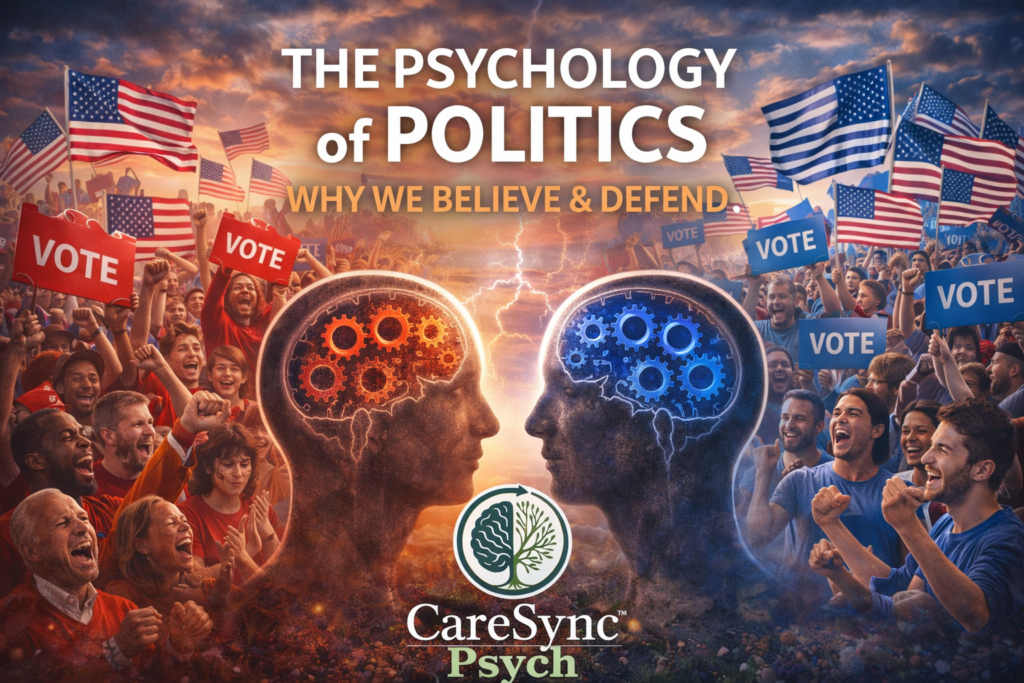
Why Politics Feels So Personal: The Psychology Behind Beliefs, Identity, and Human Nature
At CareSync Psych, we often discuss how mental health is deeply connected to the way humans think, feel, and interact & politics is no exception.
Many people assume political beliefs are formed purely through logic or facts, but psychology shows us it is much deeper than that. Research suggests our beliefs are heavily shaped by human nature, emotional experiences, upbringing, social environment, and identity formation (Cottam et al., 2022; Webster & Albertson, 2022).
From childhood, we begin learning values from our families, communities, religion, culture, and life experiences. Over time, these influences help shape what we believe is “right,” “wrong,” moral, fair, or threatening. Sociology teaches us that humans naturally seek belonging within groups, and political ideology often becomes tied to our sense of community, identity, and social belonging.
From childhood, we begin learning values from our families, communities, religion, culture, and life experiences. Over time, these influences help shape what we believe is “right,” “wrong,” moral, fair, or threatening. Sociology teaches us that humans naturally seek belonging within groups, and political ideology often becomes tied to our sense of community, identity, and social belonging.
In many ways, politics has evolved beyond policy—it has become part of personal identity. According to Mason (2022) modern politics often functions similarly to tribal affiliation, where individuals begin to emotionally attach their beliefs to who they are as a person. This is why disagreement can sometimes feel like a personal attack rather than a simple difference in opinion.
Psychologically, humans are also wired to defend their worldview. Our brains naturally seek consistency and safety, often favoring information that supports what we already believe while rejecting information that challenges us. This is known as confirmation bias, and it can make people fiercely protective of their beliefs even when presented with opposing evidence (Webster & Albertson, 2022).
Understanding this can help us recognize something important:
Most people are not simply “choosing” beliefs randomly—they are shaped by years of psychological, emotional, cultural, and social conditioning.
This does not mean every belief is correct, but it reminds us that beneath disagreement is often a person trying to make sense of the world through their own lived experiences.
Psychiatry & Mental Health Care In-person or Online in Lakeland, Florida
100% Remote Mental Health Care For The Entire State of Florida & Iowa
Understanding this can help us recognize something important:
Most people are not simply “choosing” beliefs randomly—they are shaped by years of psychological, emotional, cultural, and social conditioning.
This does not mean every belief is correct, but it reminds us that beneath disagreement is often a person trying to make sense of the world through their own lived experiences.
Psychiatry & Mental Health Care In-person or Online in Lakeland, Florida
100% Remote Mental Health Care For The Entire State of Florida & Iowa
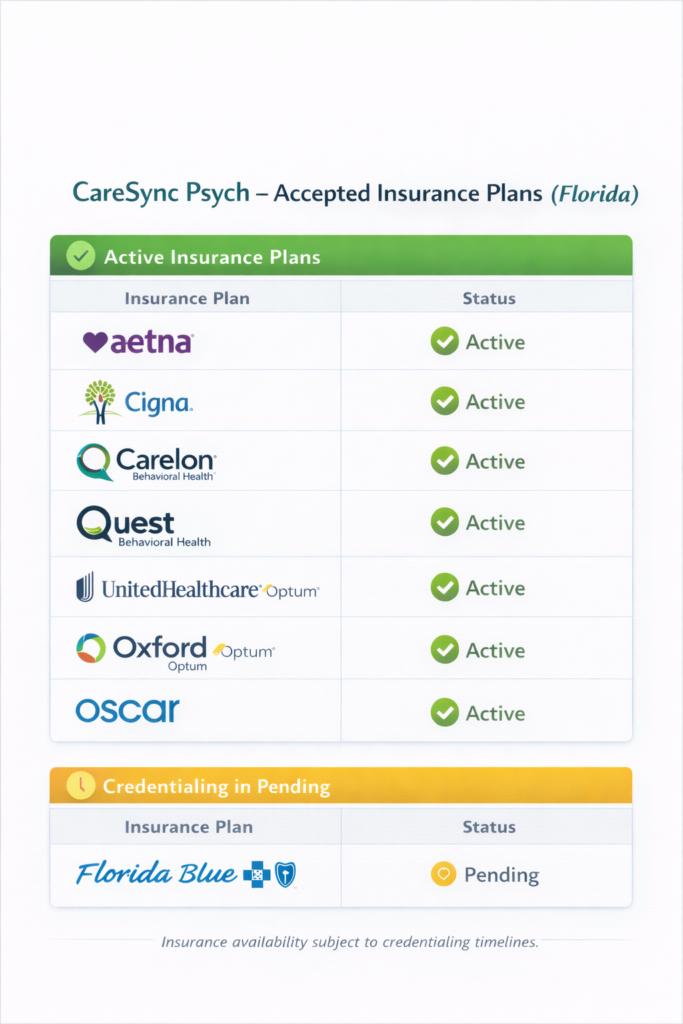
Psychiatry in Lakeland, Fl- CareSync Psych accepts:
Aetna, Cigna, Carelon, Quest, United Healthcare, Oxford and Oscar- as well as affordable self-pay options
This does not mean every belief is correct, but it reminds us that beneath disagreement is often a person trying to make sense of the world through their own lived experiences.
At CareSync Psych, we believe understanding human behavior—including why people think and react the way they do—can improve empathy, communication, emotional intelligence, and self-awareness. Sometimes growth begins when we stop asking, “Why would someone think that?” and start asking,
“What experiences shaped them to think that way?”
Understand the Mind Behind Human Behavior
At CareSync Psych, we believe understanding psychology goes far beyond symptoms and diagnoses—it helps explain why people think, feel, believe, and react the way they do. From emotions and relationships to identity, conflict, and even politics, psychology shapes every part of human behavior. Our mission is to help individuals better understand themselves, improve emotional wellness, and create meaningful, lasting change through compassionate, evidence-based mental health care.
References
Cottam, M. L., Mastors, E., & Preston, T. (2022). Introduction to political psychology. Routledge.
Mason, L. (2022). Uncivil agreement: How politics became our identity. University of Chicago Press.
Webster, S. W., & Albertson, B. (2022). Emotion and politics: Noncognitive psychological biases in public opinion. Annual Review of Political Science, 25, 401–418.