Health information
PHI may include information that identifies you and relates to your health, care, payment, prescriptions, diagnoses, communications, or treatment history.

CareSync Psych™
Mental health information is deeply personal. This page explains how CareSync Psych protects information, how it may be used, your privacy rights, and the limits of website and electronic communications.
Last updated: August 23, 2026This page is a public summary of CareSync Psych privacy and compliance practices and includes the website privacy policy. It does not replace the formal HIPAA Notice of Privacy Practices provided to patients, which describes permitted uses and disclosures of protected health information (PHI), patient rights, and CareSync Psych’s legal duties in greater detail. You may request a current copy at any time.
Your information deserves thoughtful protection
CareSync Psych provides outpatient psychiatric services in person in Florida and through telehealth where licensed and clinically appropriate, including Arizona, Florida, Iowa, and Washington.
PHI may include information that identifies you and relates to your health, care, payment, prescriptions, diagnoses, communications, or treatment history.
CareSync Psych uses administrative, physical, and technical safeguards designed to protect electronic, paper, and verbal health information as required by applicable law.
You may ask questions, request records, seek confidential communications, request certain restrictions or corrections, and file a privacy complaint without retaliation.
Protected health information
CareSync Psych may use or disclose PHI without a separate authorization when HIPAA or another law permits or requires it. Common examples include:
Other uses or disclosures generally require your written authorization. You may revoke an authorization in writing for future uses or disclosures, subject to legal limitations and actions already taken in reliance on it.
Your information • Your rights
Rights may be subject to legal exceptions, identity verification, reasonable procedures, and permitted fees. CareSync Psych will explain a denial when required and identify any review rights that apply.
Psychotherapy notes: HIPAA defines psychotherapy notes narrowly. If such notes are created and maintained separately from the medical record, they receive additional protection and are generally excluded from the HIPAA right of access. The clinical record—including diagnoses, medications, treatment plans, symptoms, progress, and visit information—is not automatically a psychotherapy note.

Mental and behavioral health information
Mental health information is protected, but confidentiality is not absolute. CareSync Psych may disclose information when authorized by you or when permitted or required by law—for example, mandated reports involving suspected abuse or neglect, valid legal process, health oversight, or circumstances involving a serious and imminent threat to health or safety.
Federal or state law may provide additional protection to particular records, including certain substance-use-disorder records, HIV information, genetic information, reproductive-health information, or records involving minors. CareSync Psych applies additional protections when those laws are applicable to the information and service involved.
Website privacy policy
Using a health care website does not automatically create a patient-provider relationship. Information submitted through public website forms may not become part of the medical record unless CareSync Psych incorporates it into patient care.
| Information category | Examples | How it may be used |
|---|---|---|
| Information you provide | Name, contact details, appointment requests, insurance inquiry information, and messages. | To respond, schedule, verify coverage, provide requested information, maintain security, and support practice operations. |
| Technical information | IP address, browser, device type, referring page, date/time, general location derived from IP, and security logs. | To operate, secure, troubleshoot, measure, and improve the website. |
| Cookies and analytics | Cookies or similar technologies that remember preferences or provide aggregated usage information. | To understand site performance and user experience. Browser settings may allow you to limit cookies, although some features may not function properly. |
| Third-party services | Scheduling, insurance verification, maps, embedded content, analytics, payment, or portal services. | These services may process information under their own terms and privacy notices. Review the privacy information shown before submitting sensitive information. |
Public contact forms, ordinary email, and social media are not intended for emergencies, detailed clinical histories, medication changes, or urgent safety concerns. Established patients should use the designated patient portal for non-urgent clinical communication.
Links to insurers, crisis services, educational resources, maps, social media, and other websites are provided for convenience. CareSync Psych does not control and is not responsible for the privacy, security, availability, or content of independent websites.
CareSync Psych does not sell PHI or sell website personal information for monetary consideration. Website vendors and technologies may change. CareSync Psych evaluates services that may receive protected health information and uses required agreements and safeguards when applicable.
Virtual psychiatric care
CareSync Psych selects and configures telehealth and electronic systems to support applicable privacy and security obligations. No technology can guarantee complete privacy or uninterrupted service.
At each telehealth visit, patients may be asked to confirm identity, current physical location, callback information, and emergency contact details. The patient must be physically located where the clinician is authorized to provide care.
Use a private space, headphones when helpful, a secure internet connection, and a device you control. Tell the provider if another person is present or if privacy cannot be maintained.
Electronic communication
By choosing electronic communication, you acknowledge its practical privacy risks. Communication preferences may be updated by contacting the office, although CareSync Psych may still send communications required for care, payment, security, or law.
Records and special circumstances
Records are retained according to applicable federal and state law, licensing requirements, payer obligations, professional standards, and CareSync Psych policy. When records are eligible for disposal, reasonable methods are used to protect confidentiality.
Parents, guardians, and other personal representatives may exercise privacy rights when recognized by applicable law. Their authority may be limited in circumstances involving a minor’s independent consent, safety concerns, abuse or neglect, confidential services, or another legal exception.
CareSync Psych reviews legal demands and discloses only as permitted or required by applicable law. A subpoena does not always authorize unrestricted access to every category of mental health information.
Privacy, consent, access, mandatory reporting, telehealth, and record-retention requirements may differ by state. When state law is more protective or imposes additional requirements, CareSync Psych applies the law relevant to the patient, service, and information involved.
Security and accountability
Policies, role-based access, workforce education, vendor review, incident response, and risk-management activities appropriate to the practice.
Reasonable controls for offices, records, workstations, devices, and areas where confidential conversations or information may be accessed.
Access controls, authentication, secure configurations, audit capabilities, transmission protections, backups, and other controls appropriate to electronic systems.
CareSync Psych uses safeguards designed to reduce privacy and security risks, but no website, email system, mobile device, telehealth platform, portal, or storage system can guarantee absolute security. Suspected incidents are evaluated and addressed, and affected individuals and government agencies are notified when required by applicable breach-notification law.
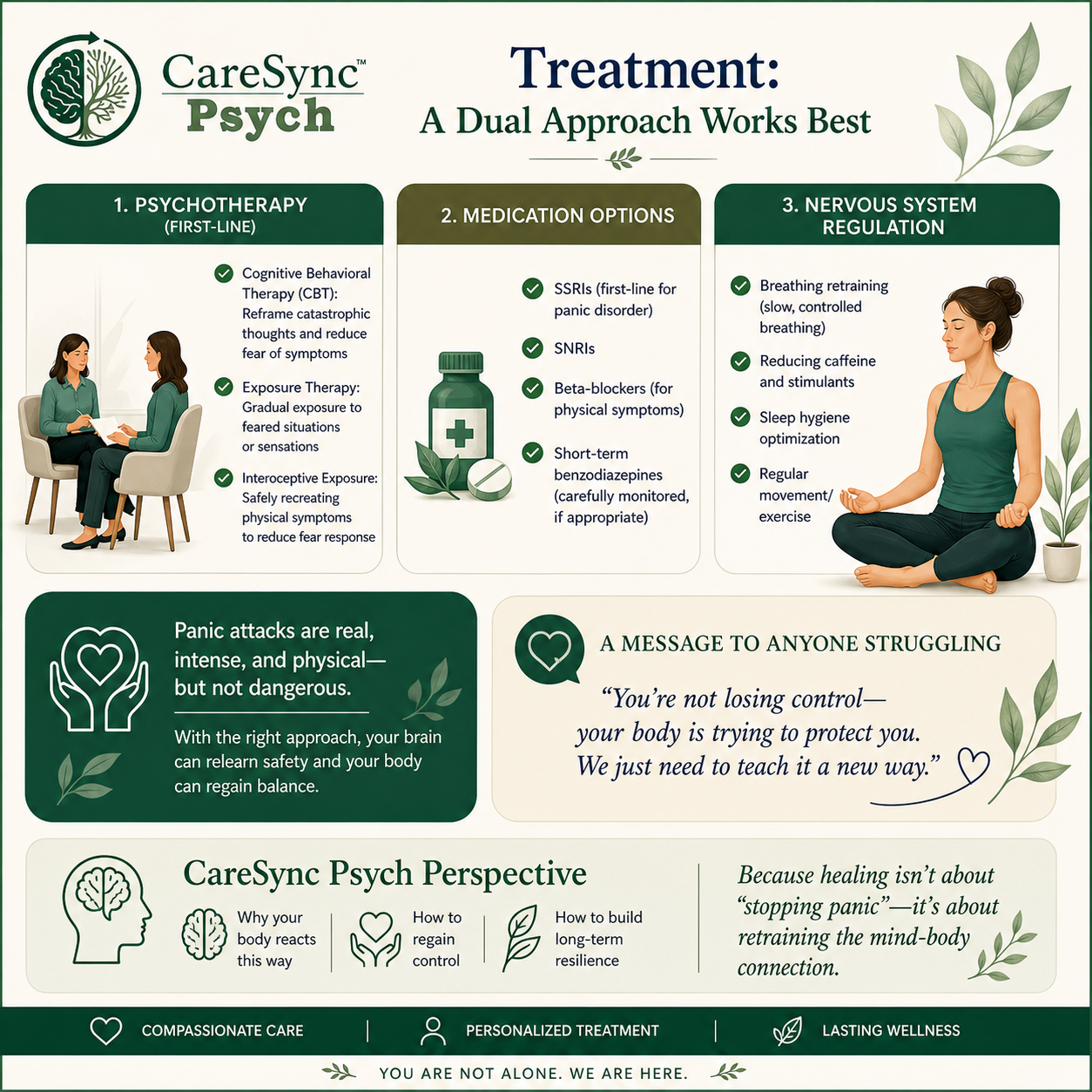
Educational and clinical-content disclaimer
Articles, illustrations, infographics, worksheets, videos, social posts, and general treatment descriptions are provided for education. They do not establish a patient-provider relationship, diagnose a condition, recommend a specific medication, replace an evaluation, or guarantee an outcome.
Treatment decisions must account for an individual’s diagnosis, history, medications, risks, preferences, location, and clinical circumstances. Do not start, stop, or change medication based only on website content.
Some images may be illustrative, digitally created, or posed by models and do not depict actual patients. Testimonials or examples, if used, do not promise similar results.
Questions and updates
Questions, requests, or complaints
Contact the Privacy Officer to request the formal Notice of Privacy Practices, exercise a privacy right, report a concern, ask how information was handled, or update communication preferences.
CareSync Psych™
Attn: Privacy Officer
180 Fitzgerald Road, Suite 2
Lakeland, FL 33813
You may also file a complaint with the U.S. Department of Health and Human Services Office for Civil Rights. CareSync Psych will not retaliate against you for submitting a good-faith complaint.
This page is intended as a patient-friendly policy summary and website privacy notice. It should be reviewed with CareSync Psych’s formal Notice of Privacy Practices, consent forms, vendor configuration, retention schedule, incident-response plan, state-specific requirements, and actual operational procedures.