Call us (863) 858-5554
HealthFlex
×
  • Home
  • About Us
    • Check Your Coverage
    • Insurance & Self-pay Options
    • Client-Centered Therapy
    • Crisis and After-Hours Care
    • Privacy Policy
  • Specializing In
    • Specializing In
    • Metabolic Psychiatry
    • Weight Management & Binge Eating
  • Services
    • Services
    • Medication Management for Mental Health
    • Telehealth
    • Client-Centered Therapy
    • Metabolic Psychiatry
  • Book An Appointment
  • Contact Us

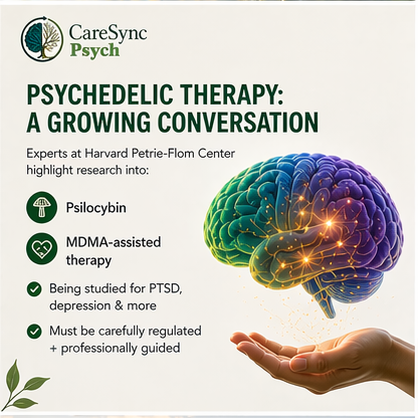
Psychedelics

Psychedelics

Psychedelics & New Psychiatry

Psychedelics in Psychiatry: How They Work, Why They Matter, and What the Future Could Hold

Psychedelics are resurfacing as one of the most debated topics in contemporary psychiatry. They were formerly completely overlooked, but are now being investigated as possible treatments for diseases such as depression, PTSD, addiction, and existential anguish. What intrigues me about psychedelics is not just their chemistry, but also the prospect that they might assist modify ingrained patterns of thinking, emotion, and behavior in ways that standard psychiatric drugs cannot. At the same time, these substances are not simply miraculous cures. The research indicates that their impacts are biological, psychological, and relational. In other words, psychedelics may be effective not because they are “magic,” but because they seem to provide a window through which the brain, mind, and therapeutic process become more adaptable.

What Are Psychedelics?

Classic psychedelics include psilocybin, LSD, mescaline, and DMT. These chemicals are known to cause dramatic alterations in perception, cognition, emotion, and sense of self (Kelmendi et al., 2022). In psychiatry, they are examined not for the perceptual alterations themselves, but for how such altered states might aid in therapeutic transformation.

How do psychedelics work?
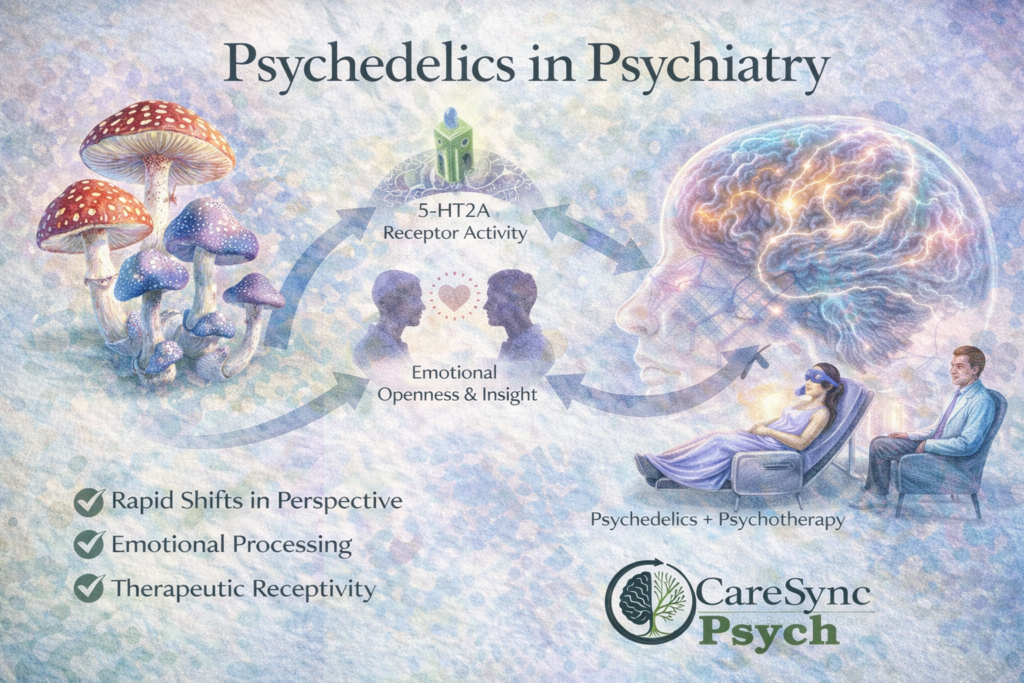
1. Serotonin receptor activity. The most commonly acknowledged pharmacologic mechanism is that traditional psychedelics predominantly operate on the 5-HT2A serotonin receptor (McClure-Begley & Roth, 2022; Van Elk & Yaden, 2022). Activation of this receptor alters cortical signaling, particularly in areas involved in perception, emotional salience, and self-referential processing.

2. Brain network disruption and flexibility. Psychedelics tend to lessen the rigidity of several large-scale brain networks, particularly the default mode network, which is linked to self-focused thinking, rumination, and habitual narrative processing (Van Elk & Yaden, 2022). This might explain why some individuals experience a transient relaxing of depressed or anxious mental patterns.

3. Therapeutically relevant psychological effects. These chemicals often produce:

Increased emotional openness

Changed meaning-making

decreased psychological defensiveness.

Improved feeling of togetherness

experiences may be defined as mystical or profound.

Never take online information as an absolute. Please perform your own research from separate scientific sources.. This post is not medical advise please ask your provider to guide your care.

According to Van Elk and Yaden (2022), these psychological impacts are not unintended. They may be essential to why psychedelics may have long-term therapeutic effects.

Why This Matters in Psychiatry

Traditional psychiatric therapies are often beneficial, yet many patients remain partly better, treatment-resistant, or functionally trapped. Psychedelics may be a unique tool since they do more than just alleviate symptoms; they may also assist disrupt deeply entrenched behaviors. According to Kelmendi et al. (2022), psychedelics are being investigated as therapies capable of promoting quick and long-term changes in mood, cognition, and behavior. This is especially important in psychiatry, where strict patterns of rumination, avoidance, trauma-related dread, or pessimism may exacerbate disease.

According to this viewpoint, psychedelics may be beneficial not just because they alter brain chemistry, but also because they improve adaptability on numerous levels:

Neural plasticity

Emotional flexibility

Cognitive openness

Therapeutic receptivity

Psychedelics Aren’t Just Pharmacology.

One of the most fundamental concepts in recent research is that psychedelic therapy is more than just consuming a chemical. Gründer et al. (2024) suggest that psychedelic treatment is equivalent to psychotherapy. The drug experience is inextricably linked to the subsequent therapeutic interaction, preparation, environment, and integration.

This is a significant change from reductionist thinking. In psychedelic treatment, the medicine and psychotherapy are inextricably linked.

This suggests that results are influenced by:

Set and setting.

clinician support

Patient Expectations

Emotional safety

Creating meaning after the event

This has significant implications for psychiatry: psychedelics may be most effective when used in conjunction with well planned psychotherapy treatment rather than as separate prescriptions.

Why Psychedelics May Be a Useful Tool

Psychedelics may be useful in psychiatry since they seem to provide something different than normal everyday drugs.

The following are some of the potential reasons they matter:

They may cause sudden alterations in attitude or viewpoint.

They may help patients access feelings that were previously denied.

They may provide a chance to process trauma, sorrow, or existential discomfort.

They may enhance the efficacy of psychotherapy in certain circumstances.

McClure-Begley and Roth (2022) define this area as having “promises and perils.” That’s a handy term. Psychedelics may be powerful tools, but strength demands prudence.

Current Research Themes

According to the material you supplied, modern psychedelic research focuses on many important themes:

1. Mechanistic understanding

Researchers are attempting to explain how much of the psychedelic advantage stems from:

receptor-level pharmacology.

alterations in brain network dynamics.

subjective experience.

Psychotherapy and Context

Van Elk and Yaden (2022) underline that no single explanation suffices. The impacts are most likely multilayered.

2. The significance of the encounter itself

A key study concern is whether the therapeutic impact is dependent on the altered state or whether a “non-hallucinogenic” variant may give comparable advantages. McClure-Begley and Roth (2022) identify this as one of the field’s fundamental disputes.

3. Integration of psychotherapy

Gründer et al. (2024) firmly believe that future models should not separate psychedelics and treatment. This shows that psychiatry may need new treatment models that are more immersive, relational, and time-consuming than traditional pharmaceutical visits.

What This Might Mean for Psychiatry

If psychedelic treatments continue to show potential, psychiatry may develop in many key directions:

A more integrated model

Psychiatry may become less focused on symptom suppression and more focused on:

Emotional Processing

Psychological flexibility

Healing in relationships

Long-term meaning and identity shifts

A reconsideration of pharmacological therapy.

Rather than everyday symptom management, some therapies may use episodic interventions in conjunction with psychotherapy.

More attention on set, location, and integration.

Client-Centered Therapy

If psychedelic treatments continue to show potential, psychiatry may develop in many key directions:

A more integrated model

Psychiatry may become less focused on symptom suppression and more focused on:

Emotional Processing

Psychological flexibility

Healing in relationships

Long-term meaning and identity shifts

A reconsideration of pharmacological therapy.

Rather than everyday symptom management, some therapies may use episodic interventions in conjunction with psychotherapy.

More attention on set, location, and integration.

Future psychiatric care may acknowledge that treatment setting is important medically and psychologically.

Potential Risks and Cautions

The enthusiasm around psychedelics should not override the necessity for care.

The risks may include:

Psychological instability in susceptible persons

worsening of psychosis or mania in susceptible people.

Overwhelming emotional sensations

Poor results in unstructured or unsupported circumstances.

McClure-Begley and Roth (2022) emphasize that, in addition to its therapeutic potential, psychedelic pharmacology contains significant hazards. These are not only health tools; they are effective cognitive therapies.

Future Implications.

The future of psychedelics in psychiatry may be dependent on various issues.

Can advantages be consistently replicated in real-world clinical settings?

What illnesses are most likely to respond?

How does psychotherapy affect long-term outcomes?

How should professionals be prepared for this work?

Can psychiatry use these ideas without overmedicalizing or simplifying them?

According to the literature, psychedelics have the potential to transform psychiatry not just by introducing new therapies, but also by changing how psychiatry perceives recovery.

Services

The CareSync Psychology Perspective

Psychedelics are gaining popularity because they might provide a fresh route for those who are locked in strict emotional and cognitive habits. Their promise is not simply in chemistry, but in the ability to create a transient condition of openness in which actual therapeutic work may take place.

At the same time, new evidence shows that these therapies should be treated mindfully, relationally, and with due regard for their complexity.

Psychiatry is finding that healing may need more than just neurotransmitters. It might also include flexibility, purpose, connection, and carefully managed change.

Never take online information as an absolute. Please perform your own research from separate scientific sources.. This post is not medical advise please ask your provider to guide your care.

References

Gründer, G., Brand, M., Mertens, L. J., Jungaberle, H., Kärtner, L., Scharf, D. J., … & Wolff, M. (2024). Treatment with psychedelics is psychotherapy: Beyond reductionism. The Lancet Psychiatry, 11(3), 231-236.

Kelmendi, B., Kaye, A. P., Pittenger, C., & Kwan, A. C. (2022). Psychedelics. Current Biology, 32(2), R63-R67.

McClure-Begley, T. D., & Roth, B. L. (2022). The promises and perils of psychedelic pharmacology for psychiatry. Nature Reviews Drug Discovery, 21(6), 463-473.

Van Elk, M., & Yaden, D. B. (2022). Pharmacological, neural, and psychological mechanisms underlying psychedelics: A critical review. Neuroscience & Biobehavioral Reviews, 140, 104793.

Fluoxetine: Why This “Oldie” is Still a Goody

Fluoxetine: Why This “Oldie” is Still a Goody

Fluoxetine: Why This “Oldie” is Still a Goody

Mental Wellness

Fluoxetine (commonly known by the brand name Prozac) was first approved in the late 1980s. That means it’s a dinosaur medication in psychiatric terms. However new research reveals that this SSRI may still have biological consequences that are much deeper than just mood management.

Never take online information as an absolute. Do your own research. This post is not medical advise please ask your provider to guide your care

This post is not medical advice. Consult with your medical provider.

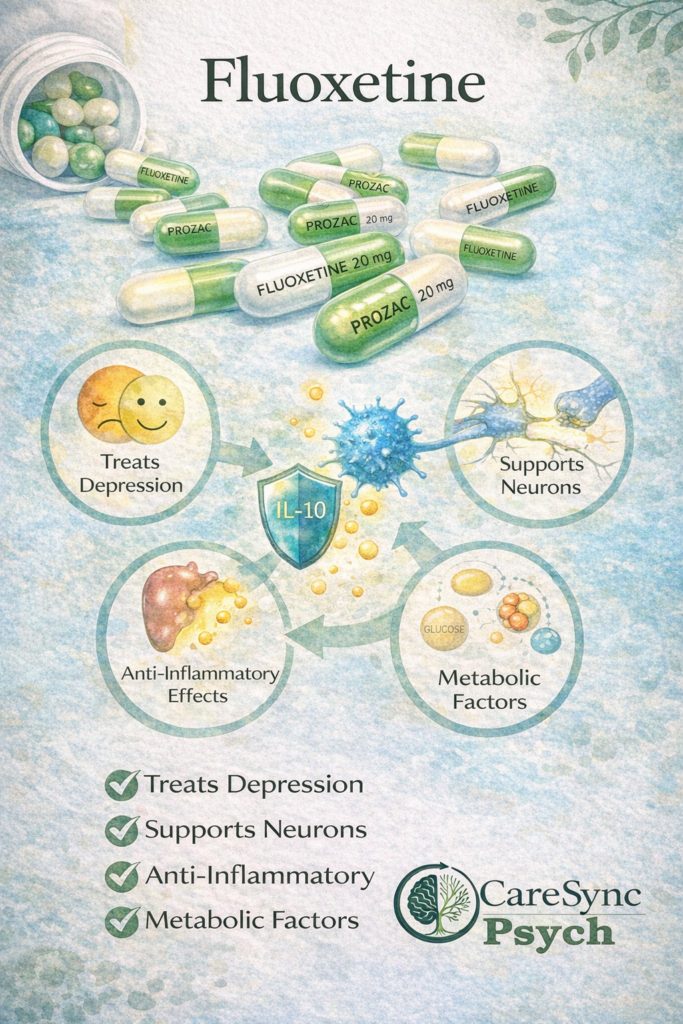
Two new studies show that fluoxetine may affect brain health, immunological function, and metabolic resilience. This suggests that the drug may have more therapeutic uses than previously thought.

Fluoxetine and Cognition

A systematic study conducted in 2024 examined the possible involvement of fluoxetine in Alzheimer’s disease and cognitive decline (Bougea et al., 2024).
Researchers discovered that fluoxetine may affect many molecular pathways associated with neurodegeneration:
• Neurogenesis—Fluoxetine may help new neurons grow, especially in the hippocampus, which is an area of the brain that is very important for memory.
• Less neuroinflammation: Long-term inflammation is a big reason why Alzheimer’s disease becomes worse. Fluoxetine seems to change how inflammation works in the brain.
• Amyloid-related pathways – Some studies done before fluoxetine was used on people show that it may affect the mechanisms that lead to amyloid plaque buildup.
• Synaptic plasticity – Fluoxetine may facilitate neuronal transmission by augmenting synaptic signaling.

Although this information does not show that fluoxetine is a medication for Alzheimer’s disease, This study suggests possibilities that the medicine may possess neuroprotective qualities that transcend its use in depression treatment.
(Bougea et al., 2024)

Fluoxetine and the Immune System

A research published in Science Advances in 2025 found something even more shocking. Researchers demonstrated that fluoxetine may boost IL-10–dependent metabolic defense mechanisms, which might help keep organisms alive after sepsis (Gallant et al., 2025). IL-10 is an important anti-inflammatory cytokine that controls immune responses and stops inflammation from becoming too bad.

The research revealed that fluoxetine can:
• turn on immune-metabolic pathways
• boost IL-10 signaling
• enhance resilience to intense inflammatory stress
This indicates that fluoxetine may affect immunological resilience and metabolic defense pathways, broadening its significance beyond psychiatry (Gallant et al., 2025).

What This Means for Mental Health

These findings indicate a broader trend in neuroscience and medicine.
Psychiatric treatments are not only “mood drugs.” They interact with a number of biological systems, such as:

Fluoxetine

Is It Depression—Or Are You Low on Vitamin D? What You Need to Know

Lithium Orotate: What the New Science Suggests (and What It Doesn’t)

Lithium Orotate: What the New Science Suggests (and What It Doesn’t)

Lithium is a naturally occurring element found in the Earth’s crust, trace amounts of water, soil, and certain foods.

It is not a synthetic drug—it exists in nature as a mineral salt and has been part of the human environment for thousands of years.

In medicine, lithium carbonate (prescription) is best known for its long-standing role in psychiatry, particularly in the treatment of bipolar disorder, mood instability, and suicide prevention. Its use in modern psychiatry dates back over 70 years.

This makes lithium carbonate (prescription version) one of the most well-studied treatments in mental health.

At CareSync Psych, lithium is understood through a mind–body, metabolic psychiatry lens, where brain chemistry, inflammation, kidney health, and overall physiology are all considered together.

Lithium Orotate

Lithium has one of the strongest evidence bases in psychiatry—especially for mood stabilization and suicide risk reduction. But lately, there’s growing buzz around a supplement form: lithium orotate.

So what does the research about lithium orotate say? Let’s start with-what is lithium orotate?


What is lithium orotate?

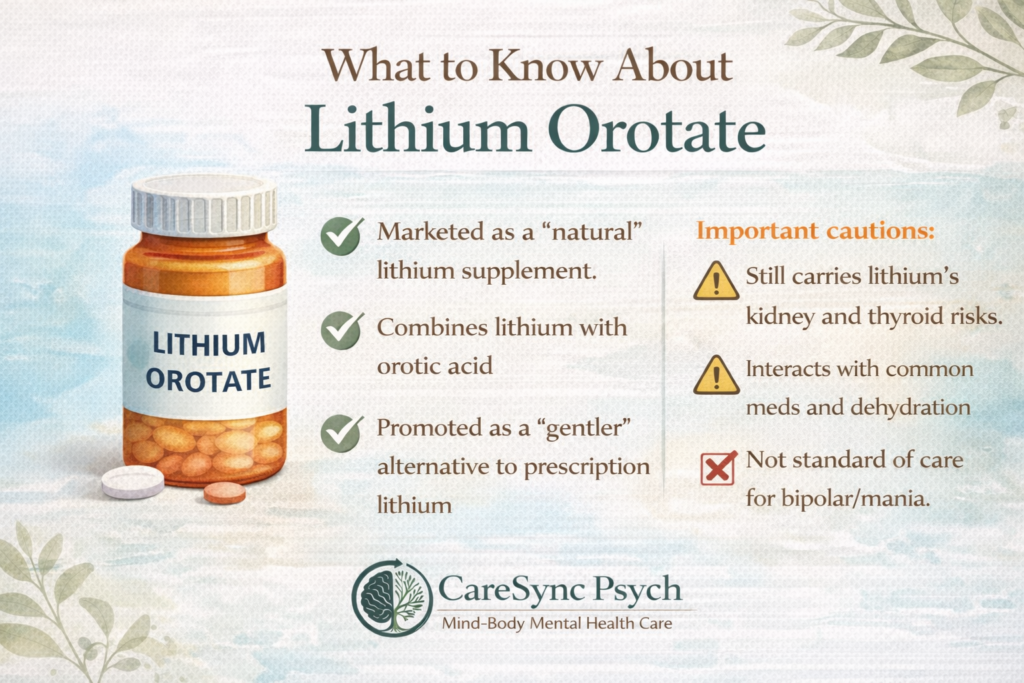
Lithium orotate is a compound where lithium is bound to orotic acid and is sold as a an over the counter dietary supplement (not a prescription medication). However, because it’s regulated differently than prescription lithium, dose consistency and quality can vary by product—and it may not be appropriate or safe for everyone (Devadason, 2018).

Potential benefits of lithium orotate

what early evidence suggests

1) Different pharmacokinetics may change potency

Preclinical work suggests lithium orotate may distribute differently in the body compared to lithium carbonate (commonly prescribed form), potentially delivering lithium to the brain more efficiently at lower doses in animal models. (Pacholko & Bekar, 2021).

2) Anti-manic effects displayed in mice model research.

In a mouse model of mania, lithium orotate showed anti-manic–like effects at lower elemental lithium doses than lithium carbonate—raising the question of whether it could be a more “potent” option in controlled settings (Pacholko & Bekar, 2023).

Is Lithium Orotate Safe to Take?

1) Human Research Trials of Lithium Orotate Are Still Very New and Limited

There are no large, high-quality human clinical trials establishing lithium orotate as a standard treatment for bipolar disorder, mania, or depression. Current discussion in the literature is cautious and exploratory (Devadason, 2018).

2) Safety and toxicity concerns remain real

A toxicological review highlights that safety depends on dose, duration, and exposure—and that “supplement” does not mean risk-free (Murbach et al., 2021).

3) Lithium is lithium—monitoring still matters

Prescription lithium requires careful monitoring because it can affect kidneys, thyroid, hydration/electrolytes, and interacts with common medications. The core clinical challenge is always balancing mental health benefits with renal safety (Strawbridge & Young, 2022).

Medication Management for Mental Health

Potential harms & interactions to know

Lithium (including lithium orotate or supplemental forms) could become unsafe with dehydration, illness, or interacting meds.

Major interaction categories include:

  • NSAIDs (ibuprofen/naproxen) → can raise lithium levels

  • ACE inhibitors / ARBs (common BP meds) → can raise lithium levels

  • Diuretics (especially thiazides) → can raise lithium levels

  • Dehydration, vomiting/diarrhea, heavy sweating → can raise lithium levels

  • Kidney disease or reduced kidney function → higher risk

  • Pregnancy/breastfeeding → requires specialist-level risk/benefit discussion

(General lithium safety principles; reinforced by clinical emphasis on renal balance in Strawbridge & Young, 2022.)

What is Metabolic Psychiatry?

Is lithium orotate ever recommended?

In mainstream psychiatric practice, lithium orotate is not a first-line or standard recommendation for bipolar disorder/mania because:

  • robust human trial evidence is lacking

  • supplement regulation and dose reliability vary

  • lithium still carries real interaction and organ-risk considerations

That said, the preclinical findings are interesting and may justify future clinical research—but for now, decisions should be individualized and medically supervised. (Devadason, 2018; Pacholko & Bekar, 2021; Pacholko & Bekar, 2023)


CareSync Psych take

If you’re considering lithium orotate because you want a “safer lithium,” here’s the safest framework:

✅ Don’t self-prescribe or combine with interacting meds
✅ Consider baseline labs and medical history (especially kidney/thyroid)
✅ Prioritize evidence-based options first
✅ If exploring supplements, do it with a clinician who understands lithium pharmacology

Weight Loss Management & Control

Book an Appointment

When the Holidays Feel Heavy: Understanding Seasonal Sadness

mD

When the Holidays Feel Heavy: Understanding Seasonal Sadness

The winter holidays are often described as magical—glowing lights, family gatherings, celebrations, and traditions that fill the season with joy. But as Kamerlin (2024) reminds us, this time of year can also bring complicated emotions. For many people, the holidays are not cheerful—they’re overwhelming, exhausting, or even painful.

If you’re struggling, you’re not alone. And nothing is “wrong” with you for feeling this way.

Why the Holidays Can Trigger Depression

1. The Pressure to Be Happy

Holidays come with a cultural script: smile, celebrate, feel grateful. Kamerlin (2024) highlights how this pressure can turn normal stress or sadness into something heavier. When everyone else seems joyful, people often hide their struggles—leading to isolation, shame, and emotional exhaustion.

2. Emotional Overload

Even positive events can be overwhelming. Preparing, hosting, traveling, managing finances, or navigating family dynamics can stretch anyone past their capacity. For those already coping with anxiety, trauma, chronic stress, or mental health conditions, the intensity of the season can amplify symptoms.

3. Grief Feels Sharper This Time of Year

The holidays tend to spotlight who is missing. Empty chairs at the table. Memories tied to traditions. Even if time has passed, grief often resurfaces—quietly, powerfully, unexpectedly.

4. Family Conflict and Relationship Stress

While some families gather with warmth, others gather with tension. Old wounds, unresolved conflict, or strained relationships may surface, and coping with these emotions can be draining.

5. Financial Strain

Gift-giving expectations, travel costs, and holiday events add financial pressure. Stress around money can quickly spiral into feelings of failure or hopelessness, especially in a season built around giving.

6. Loneliness in a Season of Togetherness

Kamerlin (2024) emphasizes an overlooked truth: many people enter the holidays feeling alone—physically, emotionally, or both. Social media only magnifies this, making everyone else’s life look picture-perfect.

7. Disruption of Routines

Sleep changes, irregular meals, altered schedules, travel, and overstimulation can destabilize mental health—especially for individuals with anxiety, depression, bipolar disorder, or OCD. Structure matters, and the holidays often remove it.


You’re Allowed to Feel What You Feel

The holidays don’t have to be perfect. They don’t have to be happy. And they don’t have to look like anyone else’s.

If this season feels heavy, give yourself permission to:

  • Take breaks

  • Set boundaries

  • Say “no” without guilt

  • Ask for help

  • Create new traditions that feel safe

  • Let go of expectations that don’t serve you

Your emotional experience is valid—even if it doesn’t match the holiday music or TV commercials.


Support Is Available

If the holiday season brings up sadness, anxiety, grief, or overwhelm, CareSync Psych is here to support you through it. Whether you need therapy, medication management, stress-reduction strategies, or a safe space to talk, you don’t have to face this season alone.

Compassion, understanding, and healing are possible—even in the middle of winter.

We are an outpatient mental health care provider committed to integrating evidence-based treatment with a holistic, healing-centered approach to promote mental wellness. Our patient-focused services include medication management, psychotherapy, metabolic psychiatry,  and wellness optimization.

“Providing compassionate mental health care by syncing the mind and body—treating the psychological with the physiological.”

Recent Posts

  • Disordered Eating
  • Understanding Political Beliefs & The Psychology of Politics
  • Transforming Your Mental Health by Healing
  • Psychedelics
  • Fluoxetine: Why This “Oldie” is Still a Goody
  • Home
  • About Us
  • Services
  • Book An Appointment
  • Contact Us
  • Weight Loss Management & Control
  • Sample Page
  • Food Addiction & Binge Eating
  • Free Mental Health Worksheets to Download

Copyright ©2026 all rights reserved
CareSync™ Health