Call us (863) 858-5554
HealthFlex
×
  • Home
  • About Us
    • Insurance & Self-pay Options
    • Crisis and After-Hours Care
    • Client-Centered Therapy
    • Privacy Policy
  • Specializing In
    • Specializing In
    • Infertility and Loss
    • Metabolic Psychiatry
    • Heal your Trauma
  • Services
    • Services
    • Medication Management for Mental Health
    • Telehealth
    • Client-Centered Therapy
    • Metabolic Psychiatry
    • Weight Management & Binge Eating
  • Book an Appointment
  • Contact Us

Lithium Orotate: What the New Science Suggests (and What It Doesn’t)

Lithium Orotate: What the New Science Suggests (and What It Doesn’t)

Lithium is a naturally occurring element found in the Earth’s crust, trace amounts of water, soil, and certain foods.

It is not a synthetic drug—it exists in nature as a mineral salt and has been part of the human environment for thousands of years.

In medicine, lithium carbonate (prescription) is best known for its long-standing role in psychiatry, particularly in the treatment of bipolar disorder, mood instability, and suicide prevention. Its use in modern psychiatry dates back over 70 years.

This makes lithium carbonate (prescription version) one of the most well-studied treatments in mental health.

At CareSync Psych, lithium is understood through a mind–body, metabolic psychiatry lens, where brain chemistry, inflammation, kidney health, and overall physiology are all considered together.

Lithium Orotate

Lithium has one of the strongest evidence bases in psychiatry—especially for mood stabilization and suicide risk reduction. But lately, there’s growing buzz around a supplement form: lithium orotate.

So what does the research about lithium orotate say? Let’s start with-what is lithium orotate?


What is lithium orotate?

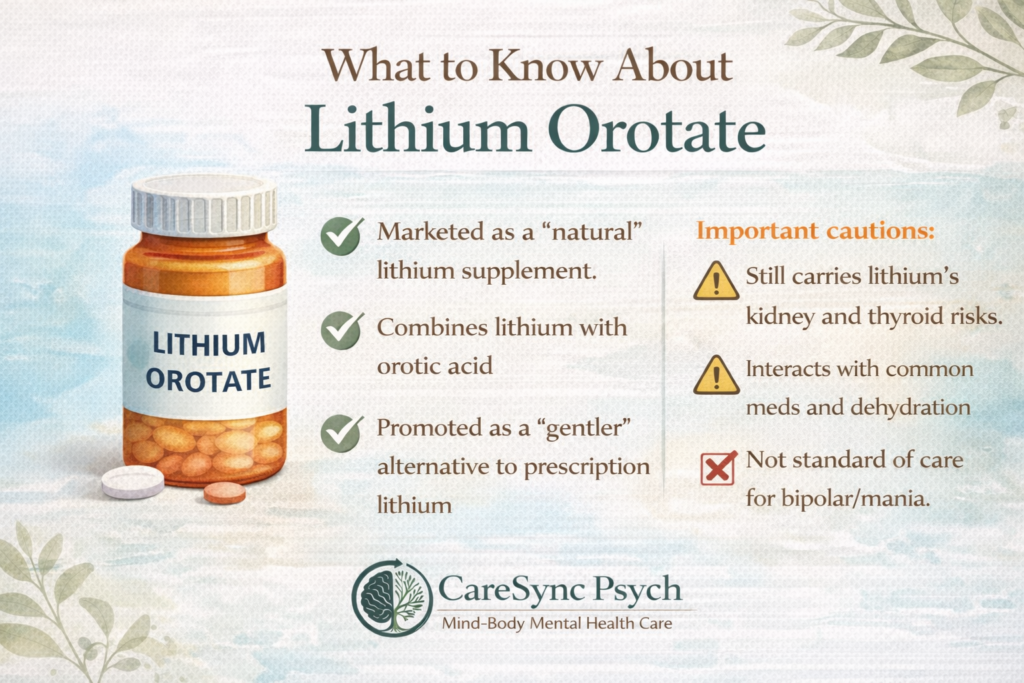
Lithium orotate is a compound where lithium is bound to orotic acid and is sold as a an over the counter dietary supplement (not a prescription medication). However, because it’s regulated differently than prescription lithium, dose consistency and quality can vary by product—and it may not be appropriate or safe for everyone (Devadason, 2018).

Potential benefits of lithium orotate

what early evidence suggests

1) Different pharmacokinetics may change potency

Preclinical work suggests lithium orotate may distribute differently in the body compared to lithium carbonate (commonly prescribed form), potentially delivering lithium to the brain more efficiently at lower doses in animal models. (Pacholko & Bekar, 2021).

2) Anti-manic effects displayed in mice model research.

In a mouse model of mania, lithium orotate showed anti-manic–like effects at lower elemental lithium doses than lithium carbonate—raising the question of whether it could be a more “potent” option in controlled settings (Pacholko & Bekar, 2023).

Is Lithium Orotate Safe to Take?

1) Human Research Trials of Lithium Orotate Are Still Very New and Limited

There are no large, high-quality human clinical trials establishing lithium orotate as a standard treatment for bipolar disorder, mania, or depression. Current discussion in the literature is cautious and exploratory (Devadason, 2018).

2) Safety and toxicity concerns remain real

A toxicological review highlights that safety depends on dose, duration, and exposure—and that “supplement” does not mean risk-free (Murbach et al., 2021).

3) Lithium is lithium—monitoring still matters

Prescription lithium requires careful monitoring because it can affect kidneys, thyroid, hydration/electrolytes, and interacts with common medications. The core clinical challenge is always balancing mental health benefits with renal safety (Strawbridge & Young, 2022).

Medication Management for Mental Health

Potential harms & interactions to know

Lithium (including lithium orotate or supplemental forms) could become unsafe with dehydration, illness, or interacting meds.

Major interaction categories include:

  • NSAIDs (ibuprofen/naproxen) → can raise lithium levels

  • ACE inhibitors / ARBs (common BP meds) → can raise lithium levels

  • Diuretics (especially thiazides) → can raise lithium levels

  • Dehydration, vomiting/diarrhea, heavy sweating → can raise lithium levels

  • Kidney disease or reduced kidney function → higher risk

  • Pregnancy/breastfeeding → requires specialist-level risk/benefit discussion

(General lithium safety principles; reinforced by clinical emphasis on renal balance in Strawbridge & Young, 2022.)

What is Metabolic Psychiatry?

Is lithium orotate ever recommended?

In mainstream psychiatric practice, lithium orotate is not a first-line or standard recommendation for bipolar disorder/mania because:

  • robust human trial evidence is lacking

  • supplement regulation and dose reliability vary

  • lithium still carries real interaction and organ-risk considerations

That said, the preclinical findings are interesting and may justify future clinical research—but for now, decisions should be individualized and medically supervised. (Devadason, 2018; Pacholko & Bekar, 2021; Pacholko & Bekar, 2023)


CareSync Psych take

If you’re considering lithium orotate because you want a “safer lithium,” here’s the safest framework:

✅ Don’t self-prescribe or combine with interacting meds
✅ Consider baseline labs and medical history (especially kidney/thyroid)
✅ Prioritize evidence-based options first
✅ If exploring supplements, do it with a clinician who understands lithium pharmacology

Weight Loss Management & Control

Book an Appointment

When the Holidays Feel Heavy: Understanding Seasonal Sadness

mD

When the Holidays Feel Heavy: Understanding Seasonal Sadness

The winter holidays are often described as magical—glowing lights, family gatherings, celebrations, and traditions that fill the season with joy. But as Kamerlin (2024) reminds us, this time of year can also bring complicated emotions. For many people, the holidays are not cheerful—they’re overwhelming, exhausting, or even painful.

If you’re struggling, you’re not alone. And nothing is “wrong” with you for feeling this way.

Why the Holidays Can Trigger Depression

1. The Pressure to Be Happy

Holidays come with a cultural script: smile, celebrate, feel grateful. Kamerlin (2024) highlights how this pressure can turn normal stress or sadness into something heavier. When everyone else seems joyful, people often hide their struggles—leading to isolation, shame, and emotional exhaustion.

2. Emotional Overload

Even positive events can be overwhelming. Preparing, hosting, traveling, managing finances, or navigating family dynamics can stretch anyone past their capacity. For those already coping with anxiety, trauma, chronic stress, or mental health conditions, the intensity of the season can amplify symptoms.

3. Grief Feels Sharper This Time of Year

The holidays tend to spotlight who is missing. Empty chairs at the table. Memories tied to traditions. Even if time has passed, grief often resurfaces—quietly, powerfully, unexpectedly.

4. Family Conflict and Relationship Stress

While some families gather with warmth, others gather with tension. Old wounds, unresolved conflict, or strained relationships may surface, and coping with these emotions can be draining.

5. Financial Strain

Gift-giving expectations, travel costs, and holiday events add financial pressure. Stress around money can quickly spiral into feelings of failure or hopelessness, especially in a season built around giving.

6. Loneliness in a Season of Togetherness

Kamerlin (2024) emphasizes an overlooked truth: many people enter the holidays feeling alone—physically, emotionally, or both. Social media only magnifies this, making everyone else’s life look picture-perfect.

7. Disruption of Routines

Sleep changes, irregular meals, altered schedules, travel, and overstimulation can destabilize mental health—especially for individuals with anxiety, depression, bipolar disorder, or OCD. Structure matters, and the holidays often remove it.


You’re Allowed to Feel What You Feel

The holidays don’t have to be perfect. They don’t have to be happy. And they don’t have to look like anyone else’s.

If this season feels heavy, give yourself permission to:

  • Take breaks

  • Set boundaries

  • Say “no” without guilt

  • Ask for help

  • Create new traditions that feel safe

  • Let go of expectations that don’t serve you

Your emotional experience is valid—even if it doesn’t match the holiday music or TV commercials.


Support Is Available

If the holiday season brings up sadness, anxiety, grief, or overwhelm, CareSync Psych is here to support you through it. Whether you need therapy, medication management, stress-reduction strategies, or a safe space to talk, you don’t have to face this season alone.

Compassion, understanding, and healing are possible—even in the middle of winter.

We are an outpatient mental health care provider committed to integrating evidence-based treatment with a holistic, healing-centered approach to promote mental wellness. Our patient-focused services include medication management, psychotherapy, metabolic psychiatry,  and wellness optimization.

“Providing compassionate mental health care by syncing the mind and body—treating the psychological with the physiological.”

Recent Posts

  • Glutathione: The Brain’s Master Antioxidant and Its Role in Aging and Mental Health
  • Lithium Orotate: What the New Science Suggests (and What It Doesn’t)
  • You Might Not Be Diabetic but You Could Be Insulin Resistant
  • Vision Boards and Mental Health: The Psychology, Science, and How to Make Them Actually Work
  • New Year, New Me? The Psychology of Making Habits Stick
  • Home
  • About Us
  • Services
  • Book an Appointment
  • Contact Us
  • Weight Loss Management & Control
  • Sample Page

Copyright ©2026 all rights reserved
CareSync™ Health