
Panic Attacks: The Attack on Your Brain & Body and Finding Treatment
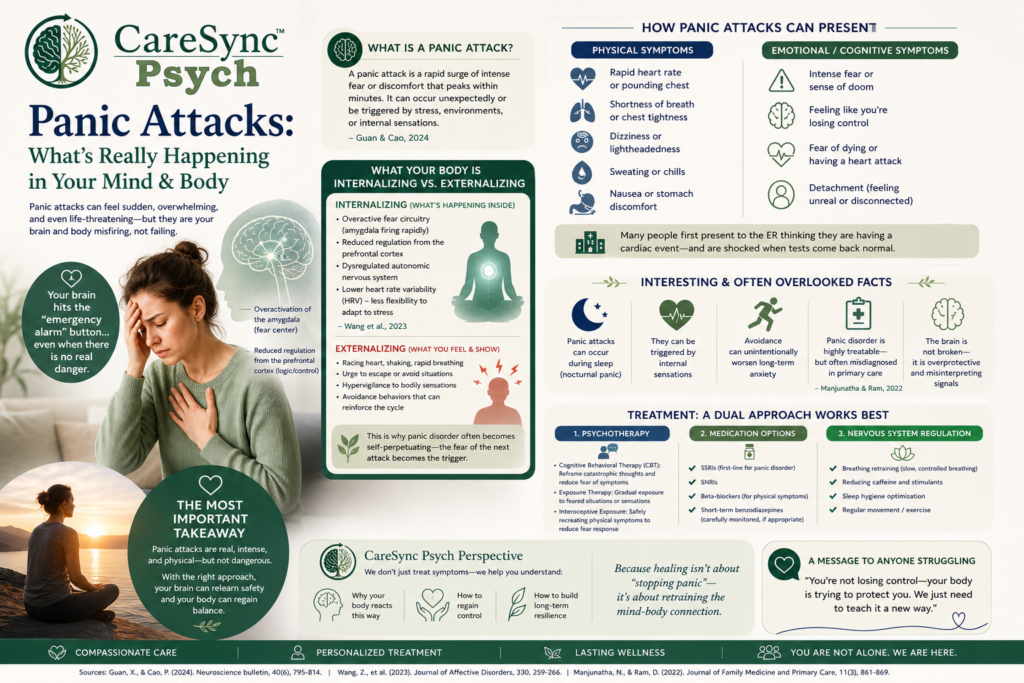
Panic attacks can feel sudden, overwhelming, and even life-threatening—but they are your brain and body misfiring, not failing.
What is a Panic Attack?
A panic attack is a rapid surge of intense fear or discomfort that peaks within minutes. It can occur unexpectedly or be triggered by stress, environments, or internal sensations.
At the neurobiological level, research by Guan & Cao (2024) shows that panic attacks involve hyperactivation of the amygdala (fear center) and dysregulation between the prefrontal cortex (logic/control) and limbic system (emotion).
👉 In simple terms:
Your brain hits the “emergency alarm” button… even when there is no real danger.
How Panic Attacks Can Present
Panic attacks are not “just anxiety”—they are full-body experiences:
Physical symptoms:
- Rapid heart rate or pounding chest
- Shortness of breath or chest tightness
- Dizziness or lightheadedness
- Sweating or chills
- Nausea or stomach discomfort
Emotional/cognitive symptoms:
- Intense fear or sense of doom
- Feeling like you’re losing control
- Fear of dying or having a heart attack
- Detachment (feeling unreal or disconnected)
💡 Many people first present to the ER thinking they are having a cardiac event—and are shocked when tests come back normal.
What Your Body is Internalizing vs. Externalizing
Internalizing (what’s happening inside):
- Overactive fear circuitry (amygdala firing rapidly)
- Reduced regulation from the prefrontal cortex
- Dysregulated autonomic nervous system
- Lower heart rate variability (HRV)—meaning the body has less flexibility to adapt to stress (Wang et al., 2023)
👉 Low HRV = the nervous system is “stuck” in fight-or-flight mode
Externalizing (what you feel and show):
- Racing heart, shaking, rapid breathing
- Urge to escape or avoid situations
- Hypervigilance to bodily sensations
- Avoidance behaviors that can reinforce the cycle
This is why panic disorder often becomes self-perpetuating—the fear of the next attack becomes the trigger.
Interesting & Often Overlooked Facts
✨ Panic attacks can occur during sleep (nocturnal panic)
✨ They can be triggered by internal sensations, like slight changes in breathing or heart rate
✨ Avoidance (e.g., skipping places, activities) can unintentionally worsen long-term anxiety
✨ Panic disorder is highly treatable—but often misdiagnosed in primary care (Manjunatha & Ram, 2022)
✨ The brain is not broken—it is overprotective and misinterpreting signals
Panic Attacks and Treatment: A Dual Approach Works Best
At CareSync Psych, we focus on treating both the brain AND the body.
1. Psychotherapy (First-Line)
- Cognitive Behavioral Therapy (CBT):
Helps reframe catastrophic thoughts and reduce fear of symptoms - Exposure Therapy:
Gradual exposure to feared sensations or situations - Interoceptive Exposure:
Safely recreating physical symptoms (like increased heart rate) to reduce fear response
2. Medication for Panic Disorder
- SSRIs (first-line for panic disorder)
- SNRIs
- Beta-blockers (for physical symptoms)
- Short-term benzodiazepines (carefully monitored, if appropriate)
3. Nervous System Regulation with Panic Attacks
- Breathing retraining (slow, controlled breathing)
- Reducing caffeine and stimulants
- Sleep hygiene optimization
- Regular movement/exercise
The Most Important Takeaway
Panic attacks are real, intense, and physical—but not dangerous.
With the right approach, your brain can relearn safety and your body can regain balance.
CareSync Psych Perspective
We don’t just treat symptoms—we help you understand:
- Why your body reacts this way
- How to regain control
- How to build long-term resilience
Because healing isn’t about “stopping panic”—
it’s about retraining the mind-body connection.
A Message to Anyone Struggling
“You’re not losing control—your body is trying to protect you.
We just need to teach it a new way.”
References
Guan, X., & Cao, P. (2024). Brain mechanisms underlying panic attack and panic disorder. Neuroscience Bulletin, 40(6), 795–814. https://doi.org/10.1007/s12264-024-01123-3
Manjunatha, N., & Ram, D. (2022). Panic disorder in general medical practice: A narrative review. Journal of Family Medicine and Primary Care, 11(3), 861–869. https://doi.org/10.4103/jfmpc.jfmpc_1440_21
Wang, Z., Luo, Y., Zhang, Y., Chen, L., Zou, Y., Xiao, J., … Zou, Z. (2023). Heart rate variability in generalized anxiety disorder, major depressive disorder and panic disorder: A network meta-analysis and systematic review. Journal of Affective Disorders, 330, 259–266. https://doi.org/10.1016/j.jad.2023.02.021