
Psychedelics & New Psychiatry
Psychedelics in Psychiatry: How They Work, Why They Matter, and What the Future Could Hold
Psychedelics are resurfacing as one of the most debated topics in contemporary psychiatry. They were formerly completely overlooked, but are now being investigated as possible treatments for diseases such as depression, PTSD, addiction, and existential anguish. What intrigues me about psychedelics is not just their chemistry, but also the prospect that they might assist modify ingrained patterns of thinking, emotion, and behavior in ways that standard psychiatric drugs cannot. At the same time, these substances are not simply miraculous cures. The research indicates that their impacts are biological, psychological, and relational. In other words, psychedelics may be effective not because they are “magic,” but because they seem to provide a window through which the brain, mind, and therapeutic process become more adaptable.
What Are Psychedelics?
Classic psychedelics include psilocybin, LSD, mescaline, and DMT. These chemicals are known to cause dramatic alterations in perception, cognition, emotion, and sense of self (Kelmendi et al., 2022). In psychiatry, they are examined not for the perceptual alterations themselves, but for how such altered states might aid in therapeutic transformation.
How do psychedelics work?
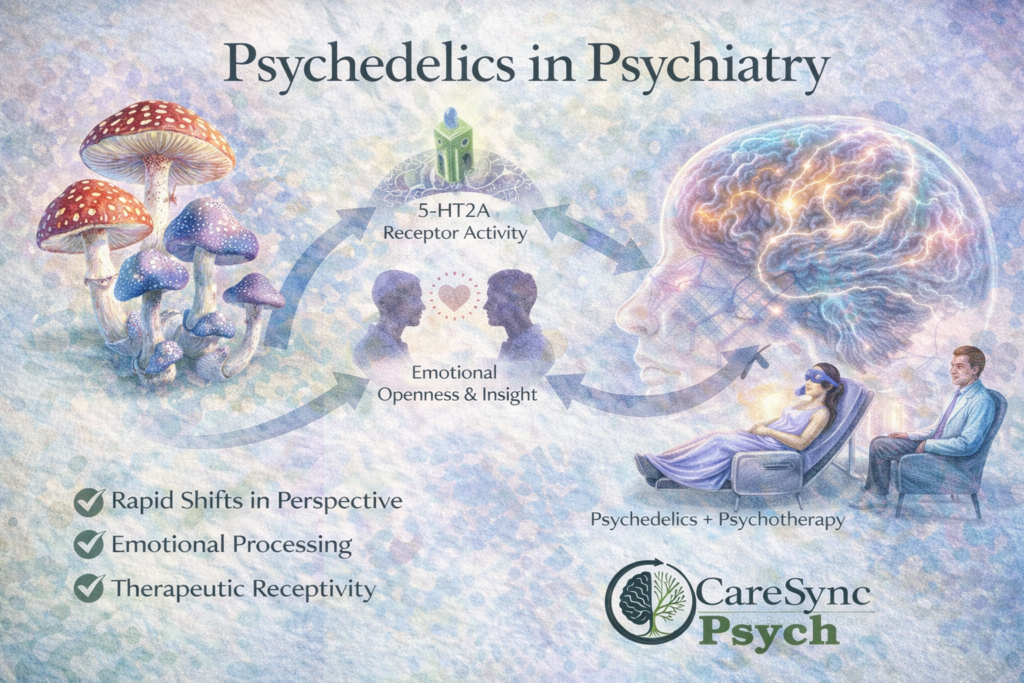
1. Serotonin receptor activity. The most commonly acknowledged pharmacologic mechanism is that traditional psychedelics predominantly operate on the 5-HT2A serotonin receptor (McClure-Begley & Roth, 2022; Van Elk & Yaden, 2022). Activation of this receptor alters cortical signaling, particularly in areas involved in perception, emotional salience, and self-referential processing.
2. Brain network disruption and flexibility. Psychedelics tend to lessen the rigidity of several large-scale brain networks, particularly the default mode network, which is linked to self-focused thinking, rumination, and habitual narrative processing (Van Elk & Yaden, 2022). This might explain why some individuals experience a transient relaxing of depressed or anxious mental patterns.
3. Therapeutically relevant psychological effects. These chemicals often produce:
Increased emotional openness
Changed meaning-making
decreased psychological defensiveness.
Improved feeling of togetherness
experiences may be defined as mystical or profound.
According to Van Elk and Yaden (2022), these psychological impacts are not unintended. They may be essential to why psychedelics may have long-term therapeutic effects.
Why This Matters in Psychiatry
Traditional psychiatric therapies are often beneficial, yet many patients remain partly better, treatment-resistant, or functionally trapped. Psychedelics may be a unique tool since they do more than just alleviate symptoms; they may also assist disrupt deeply entrenched behaviors. According to Kelmendi et al. (2022), psychedelics are being investigated as therapies capable of promoting quick and long-term changes in mood, cognition, and behavior. This is especially important in psychiatry, where strict patterns of rumination, avoidance, trauma-related dread, or pessimism may exacerbate disease.
According to this viewpoint, psychedelics may be beneficial not just because they alter brain chemistry, but also because they improve adaptability on numerous levels:
Neural plasticity
Emotional flexibility
Cognitive openness
Therapeutic receptivity
Psychedelics Aren’t Just Pharmacology.
One of the most fundamental concepts in recent research is that psychedelic therapy is more than just consuming a chemical. Gründer et al. (2024) suggest that psychedelic treatment is equivalent to psychotherapy. The drug experience is inextricably linked to the subsequent therapeutic interaction, preparation, environment, and integration.
This is a significant change from reductionist thinking. In psychedelic treatment, the medicine and psychotherapy are inextricably linked.
This suggests that results are influenced by:
Set and setting.
clinician support
Patient Expectations
Emotional safety
Creating meaning after the event
This has significant implications for psychiatry: psychedelics may be most effective when used in conjunction with well planned psychotherapy treatment rather than as separate prescriptions.
Why Psychedelics May Be a Useful Tool
Psychedelics may be useful in psychiatry since they seem to provide something different than normal everyday drugs.
The following are some of the potential reasons they matter:
They may cause sudden alterations in attitude or viewpoint.
They may help patients access feelings that were previously denied.
They may provide a chance to process trauma, sorrow, or existential discomfort.
They may enhance the efficacy of psychotherapy in certain circumstances.
McClure-Begley and Roth (2022) define this area as having “promises and perils.” That’s a handy term. Psychedelics may be powerful tools, but strength demands prudence.
Current Research Themes
According to the material you supplied, modern psychedelic research focuses on many important themes:
1. Mechanistic understanding
Researchers are attempting to explain how much of the psychedelic advantage stems from:
receptor-level pharmacology.
alterations in brain network dynamics.
subjective experience.
Psychotherapy and Context
Van Elk and Yaden (2022) underline that no single explanation suffices. The impacts are most likely multilayered.
2. The significance of the encounter itself
A key study concern is whether the therapeutic impact is dependent on the altered state or whether a “non-hallucinogenic” variant may give comparable advantages. McClure-Begley and Roth (2022) identify this as one of the field’s fundamental disputes.
3. Integration of psychotherapy
Gründer et al. (2024) firmly believe that future models should not separate psychedelics and treatment. This shows that psychiatry may need new treatment models that are more immersive, relational, and time-consuming than traditional pharmaceutical visits.
What This Might Mean for Psychiatry
If psychedelic treatments continue to show potential, psychiatry may develop in many key directions:
A more integrated model
Psychiatry may become less focused on symptom suppression and more focused on:
Emotional Processing
Psychological flexibility
Healing in relationships
Long-term meaning and identity shifts
A reconsideration of pharmacological therapy.
Rather than everyday symptom management, some therapies may use episodic interventions in conjunction with psychotherapy.
More attention on set, location, and integration.
If psychedelic treatments continue to show potential, psychiatry may develop in many key directions:
A more integrated model
Psychiatry may become less focused on symptom suppression and more focused on:
Emotional Processing
Psychological flexibility
Healing in relationships
Long-term meaning and identity shifts
A reconsideration of pharmacological therapy.
Rather than everyday symptom management, some therapies may use episodic interventions in conjunction with psychotherapy.
More attention on set, location, and integration.
Future psychiatric care may acknowledge that treatment setting is important medically and psychologically.
Potential Risks and Cautions
The enthusiasm around psychedelics should not override the necessity for care.
The risks may include:
Psychological instability in susceptible persons
worsening of psychosis or mania in susceptible people.
Overwhelming emotional sensations
Poor results in unstructured or unsupported circumstances.
McClure-Begley and Roth (2022) emphasize that, in addition to its therapeutic potential, psychedelic pharmacology contains significant hazards. These are not only health tools; they are effective cognitive therapies.
Future Implications.
The future of psychedelics in psychiatry may be dependent on various issues.
Can advantages be consistently replicated in real-world clinical settings?
What illnesses are most likely to respond?
How does psychotherapy affect long-term outcomes?
How should professionals be prepared for this work?
Can psychiatry use these ideas without overmedicalizing or simplifying them?
According to the literature, psychedelics have the potential to transform psychiatry not just by introducing new therapies, but also by changing how psychiatry perceives recovery.
The CareSync Psychology Perspective
Psychedelics are gaining popularity because they might provide a fresh route for those who are locked in strict emotional and cognitive habits. Their promise is not simply in chemistry, but in the ability to create a transient condition of openness in which actual therapeutic work may take place.
At the same time, new evidence shows that these therapies should be treated mindfully, relationally, and with due regard for their complexity.
Psychiatry is finding that healing may need more than just neurotransmitters. It might also include flexibility, purpose, connection, and carefully managed change.
References
Gründer, G., Brand, M., Mertens, L. J., Jungaberle, H., Kärtner, L., Scharf, D. J., … & Wolff, M. (2024). Treatment with psychedelics is psychotherapy: Beyond reductionism. The Lancet Psychiatry, 11(3), 231-236.
Kelmendi, B., Kaye, A. P., Pittenger, C., & Kwan, A. C. (2022). Psychedelics. Current Biology, 32(2), R63-R67.
McClure-Begley, T. D., & Roth, B. L. (2022). The promises and perils of psychedelic pharmacology for psychiatry. Nature Reviews Drug Discovery, 21(6), 463-473.
Van Elk, M., & Yaden, D. B. (2022). Pharmacological, neural, and psychological mechanisms underlying psychedelics: A critical review. Neuroscience & Biobehavioral Reviews, 140, 104793.