
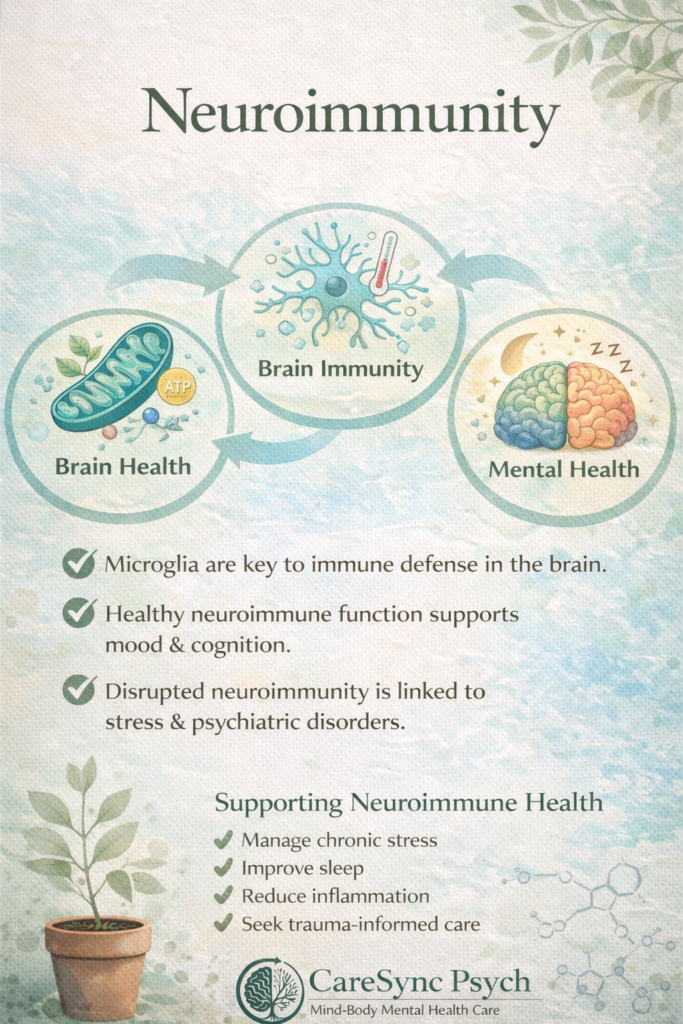
Neuroimmunity and Mental Health:
Why the Immune System in the Brain Matters More Than We Once Thought
Why Neuroimmunity Is Important for Mental Health
Stress Directly Alters Brain Immune Function
Chronic psychological stress does not just affect mood—it reprograms microglial activity. Prolonged stress exposure can lead to:
-
Increased neuroinflammation
-
Impaired synaptic plasticity
-
Altered emotional processing
This helps explain why chronic stress increases vulnerability to depression, anxiety, and trauma-related disorders (Sequeira & Bolton, 2023).
Bipolar Disorder and Neuroimmune Dysregulation
Recent evidence supports a neuroimmune hypothesis of bipolar disorder, suggesting that microglial dysfunction contributes to mood instability, neuroprogression, and cognitive changes.
Chaves-Filho et al. (2024) describe how altered microglial signaling and inflammatory markers are consistently observed in bipolar disorder, even outside of acute mood episodes. This suggests that immune dysregulation may be a core feature, not just a secondary effect.
PTSD, Anhedonia, and Immune Suppression
Neuroimmunity is not always about excessive inflammation. In some conditions, immune activity may be suppressed or dysregulated in the opposite direction.
Bonomi et al. (2024) found that microglia-mediated neuroimmune suppression in PTSD was associated with anhedonia, the inability to experience pleasure. This highlights how both overactivation and underactivation of neuroimmune pathways can impair emotional functioning.
Supporting the brain’s immune system is not alternative—it is emerging neuroscience.
What Neuroimmunity Means for Brain Health
Healthy neuroimmune function supports:
-
Cognitive clarity
-
Emotional regulation
-
Stress resilience
-
Neural repair and plasticity
Dysregulated neuroimmunity is increasingly linked to:
-
Depression
-
Bipolar disorder
-
PTSD
-
Cognitive impairment
-
Fatigue and brain fog
This shifts mental health care away from a purely “chemical imbalance” model toward a systems-based brain health model.
What We Can Do to Support Neuroimmune Health
Neuroimmunity is modifiable. While not everything is within personal control, evidence suggests several modifiable factors influence microglial health.
1. Reduce Chronic Stress Load
Persistent stress is one of the strongest drivers of neuroimmune dysregulation. Therapy, nervous system regulation, and adequate recovery time are foundational.
2. Address Sleep and Circadian Health
Sleep disruption directly alters microglial activity. Restorative sleep is essential for immune regulation in the brain.
3. Support Metabolic Health
Insulin resistance, obesity, and metabolic dysfunction are associated with systemic inflammation that crosses into the brain. Metabolic psychiatry recognizes this brain–body link
4. Treat Psychiatric Conditions Early and Consistently
Untreated or recurrent episodes of mood and trauma-related disorders may contribute to neuroimmune sensitization over time.
5. Consider a Whole-Person Treatment Model
Psychotherapy, medication when appropriate, lifestyle interventions, and medical evaluation work together to reduce neuroimmune burden.

A CareSync Psych Perspective
At CareSync Psych, neuroimmunity reinforces an important truth:
Mental health is not separate from physical health.
The brain responds to stress, trauma, metabolism, sleep, and inflammation. When we treat mental health through a whole-person lens, we are supporting the immune system of the brain—not just neurotransmitters.
This perspective does not replace therapy or medication—it enhances their effectiveness by addressing upstream contributors to psychiatric symptoms.
Understanding neuroimmune health moves mental health care toward precision, prevention, and integration.
Supporting the brain’s immune system is not alternative—it is emerging neuroscience.
References (APA)
Bonomi, R., Hillmer, A. T., Woodcock, E., Bhatt, S., Rusowicz, A., Angarita, G. A., et al. (2024). Microglia-mediated neuroimmune suppression in PTSD is associated with anhedonia. Proceedings of the National Academy of Sciences, 121(35), e2406005121. https://doi.org/10.1073/pnas.2406005121
Chaves-Filho, A., Eyres, C., Blöbaum, L., Landwehr, A., & Tremblay, M. È. (2024). The emerging neuroimmune hypothesis of bipolar disorder: An updated overview of neuroimmune and microglial findings. Journal of Neurochemistry, 168(9), 1780–1816.
Sequeira, M. K., & Bolton, J. L. (2023). Stressed microglia: Neuroendocrine–neuroimmune interactions in the stress response. Endocrinology, 164(7), bqad088. https://doi.org/10.1210/endocr/bqad088