
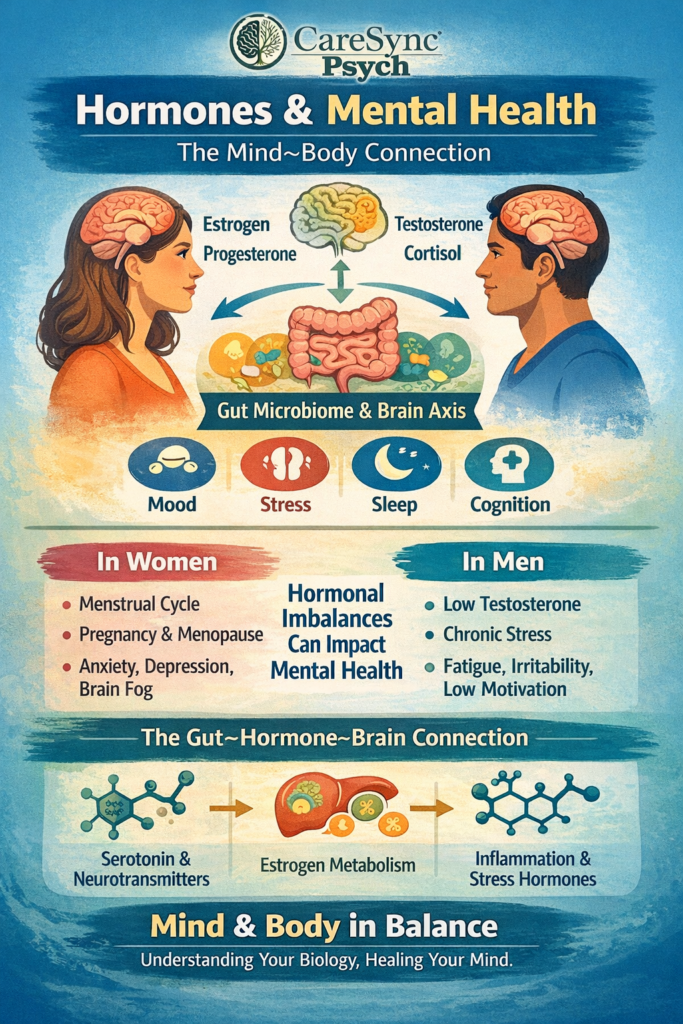
Hormones & Mental Health: Why Your Biology Matters
CareSync Psych | Mind–Body Mental Health Care
Mental health is not “all in your head.” It is deeply rooted in biology—and hormones play a central role in how we think, feel, cope, and heal. At CareSync Psych, we approach mental health through a whole-person lens, recognizing that hormones, brain chemistry, the gut, and stress systems are constantly communicating.
Below is a clear, science-informed look at what hormones are, why they matter, and how hormonal shifts in women and men can meaningfully impact mental wellbeing.
What Are Hormones—and Why Do They Affect Mental Health?
Hormones are chemical messengers released by endocrine glands (such as the ovaries, testes, adrenal glands, thyroid, and gut). They travel through the bloodstream and influence nearly every system in the body, including:
-
Mood and emotional regulation
-
Stress response and resilience
-
Sleep–wake cycles
-
Energy, motivation, and cognition
-
Appetite, cravings, and weight regulation
The brain is both a target and a regulator of hormones. When hormones fluctuate or fall out of balance, the brain’s neurotransmitters (like serotonin, dopamine, GABA, and glutamate) are directly affected—shaping anxiety, depression, irritability, focus, and emotional stability.
Women, Hormones & Mental Health
Women experience more frequent and dynamic hormonal shifts across the lifespan, which helps explain why certain mood and anxiety conditions are more prevalent in women.
Key Hormones Involved
-
Estrogen – Supports serotonin, dopamine, neuroplasticity, and stress buffering
-
Progesterone – Has calming, GABA-modulating effects; low levels can increase anxiety and insomnia
-
Cortisol – The stress hormone; chronic elevation worsens anxiety, depression, and burnout
Common Hormonal Transition Points
-
Puberty
-
Menstrual cycle (PMDD, cyclical anxiety/depression)
-
Pregnancy & postpartum
-
Perimenopause & menopause
When estrogen or progesterone fluctuate or decline, many women experience:
-
Increased anxiety or panic symptoms
-
Depressive episodes
-
Irritability or emotional reactivity
-
Brain fog and sleep disruption
These symptoms are biological, not personal weakness—and they are treatable.
Men, Hormones & Mental Health
Hormonal influences on men’s mental health are often overlooked, yet they are just as impactful.
Key Hormones Involved
-
Testosterone – Influences motivation, confidence, mood stability, and cognition
-
Cortisol – Chronic stress suppresses testosterone and worsens mood symptoms
Low or declining testosterone (due to aging, chronic stress, sleep deprivation, inflammation, or metabolic dysfunction) can contribute to:
-
Depression and apathy
-
Anxiety and irritability
-
Fatigue and low motivation
-
Cognitive slowing and poor concentration
Mental health symptoms in men are frequently misattributed to “stress” alone, when hormonal and metabolic factors are significant drivers.
The Gut–Hormone–Brain Connection
Hormones do not operate in isolation. The gut microbiome plays a critical role in regulating hormones and mental health through what is known as the gut–brain axis.
The gut:
-
Produces and modulates neurotransmitters (including serotonin)
-
Influences estrogen metabolism (the “estrobolome”)
-
Affects inflammation and cortisol signaling
Gut imbalance, chronic stress, poor nutrition, or metabolic dysfunction can worsen:
-
Anxiety and depression
-
Hormonal instability
-
Brain fog and emotional dysregulation
This is why addressing gut health and metabolic factors is increasingly recognized as essential in modern psychiatric care.
Why This Matters in Mental Health Treatment
Traditional psychiatry often focuses only on symptoms. A hormone-informed approach asks deeper questions:
-
What biological systems are driving these symptoms?
-
Are hormonal shifts, stress physiology, or metabolic health contributing?
At CareSync Psych, we integrate:
-
Psychiatric evaluation and medication management
-
Hormone-aware mental health assessment
-
Lifestyle and stress-regulation strategies
-
Gut–brain and metabolic considerations
This allows treatment to be more precise, compassionate, and effective.