New Year, New Me? The Psychology of Making Habits Stick
Every January, millions of people set New Year’s resolutions with genuine hope and motivation. Eat healthier. Exercise more. Reduce stress. Improve mental health.
And yet, by February, most resolutions have quietly faded.
This isn’t because people lack discipline or motivation. Science tells us something very different: the way we approach change is often mismatched with how the brain actually forms habits.
Understanding the psychology behind New Year’s resolutions can transform “New Year, New Me” from a cycle of disappointment into sustainable growth.
Why New Year’s Resolutions Often Fail
The idea of a “fresh start” is psychologically powerful. New Years symbolize renewal, identity change, and possibility. However, research shows that good intentions alone are rarely enough to override deeply ingrained habits.
The Intention–Behavior Gap
According to Pope et al. (2014), people frequently intend to make healthier choices in the new year, but real-world behavior often contradicts those goals. Their research on food shopping found that even individuals with strong health intentions continued purchasing the same foods they always had.
Why? Because habits are automatic, not logical.
The brain defaults to familiar routines—especially under stress, time pressure, or emotional fatigue.
Habits Are Not Decisions — They Are Systems
Healthy behavior change doesn’t come from willpower alone. It comes from environmental design, repetition, and emotional regulation.
Maddox and Maddox (2006) emphasized that successful New Year’s resolutions tend to be:
-
Specific rather than vague
-
Gradual rather than extreme
-
Integrated into daily routines
-
Supported by realistic expectations
When resolutions are too broad (“I’ll be healthier”) or too rigid (“I’ll never eat sugar again”), the brain resists them.
The “Res-Illusion” Effect
Pope et al. (2014) coined the idea of New Year’s “res-illusions”—the belief that intention alone will override habit. In reality, behavior is driven by:
-
Convenience
-
Availability
-
Stress levels
-
Emotional states
-
Learned routines
This explains why motivation feels high in January but disappears once life resumes its usual pace.
A Healthier “New Year, New Me” Mindset
Rather than reinventing yourself, psychology suggests a more sustainable approach:
New Year, Same You — With Better Support.
Roberts emphasizes that wellbeing is cultivated through community, self-compassion, and intentional environments, not isolation or perfectionism. Thriving doesn’t come from self-criticism; it comes from systems that support growth.
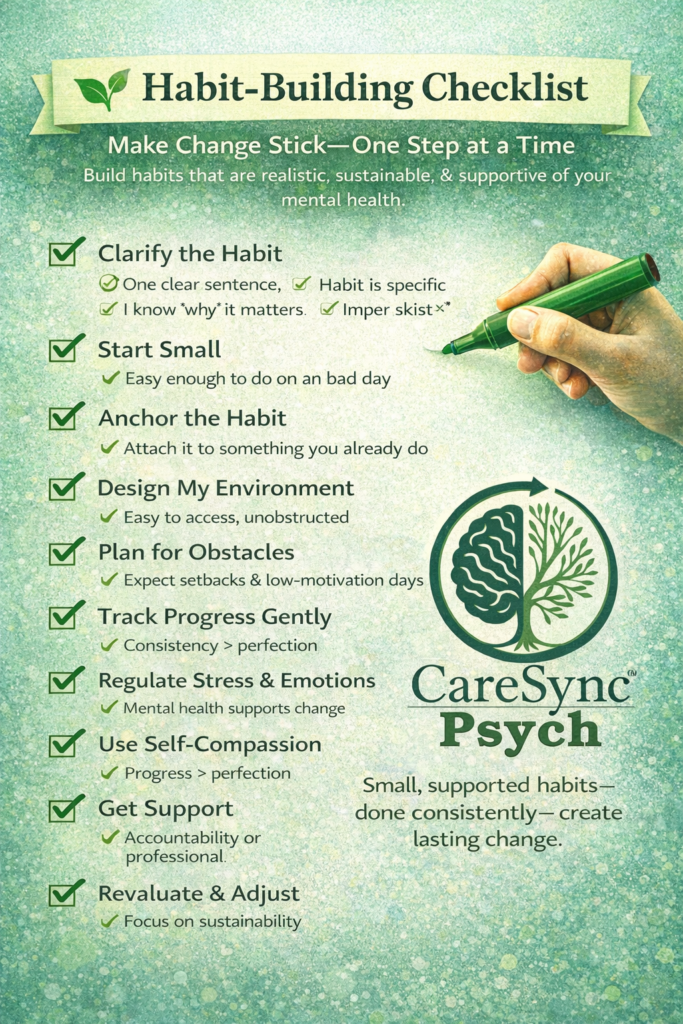
How to Make Habits Stick (What Science Supports)
Here are evidence-based strategies to help habits last beyond January.
1. Focus on Identity, Not Outcomes
Instead of “I want to lose weight,” try:
“I am someone who takes care of my body.”
Identity-based habits are more durable.
2. Start Smaller Than You Think
The brain adapts best to small, repeatable actions:
-
5 minutes of movement
-
One healthier meal per day
-
One consistent bedtime
Consistency beats intensity.
How to Make Habits Stick (What Science Supports)
Here are evidence-based strategies to help habits last beyond January.
1. Focus on Identity, Not Outcomes
Instead of “I want to lose weight,” try:
“I am someone who takes care of my body.”
Identity-based habits are more durable.
2. Start Smaller Than You Think
The brain adapts best to small, repeatable actions:
-
5 minutes of movement
-
One healthier meal per day
-
One consistent bedtime
Consistency beats intensity.
3. Design Your Environment
Habits are easier when the environment supports them:
-
Healthy foods visible
-
Unhealthy options less accessible
-
Medications placed where you’ll see them
This aligns with findings from Pope et al. (2014) on food purchasing behavior.
4. Expect Setbacks — Plan for Them
Setbacks are not failure; they are part of habit formation. Planning for lapses prevents all-or-nothing thinking.
5. Pair New Habits With Existing Ones
This is called habit stacking:
-
Stretch after brushing teeth
-
Meditate after morning coffee
-
Walk after dinner
6. Regulate Stress First
Chronic stress sabotages habit change. Anxiety, poor sleep, and burnout make consistency harder.
Mental health support improves habit success.
7. Make Goals Measurable and Flexible
Maddox and Maddox (2006) emphasize realistic goal-setting:
-
“Walk 3 days per week” instead of “exercise more”
-
Adjust goals as life changes
8. Focus on Progress, Not Perfection
Perfectionism increases shame and decreases follow-through. Sustainable habits are imperfect by nature.
9. Use Community and Accountability
Roberts highlights the importance of connection and shared values. Habits are more likely to stick when supported by others.
10. Align Habits With Mental Health
Anxiety, depression, and burnout interfere with motivation. Addressing mental health improves energy, focus, and consistency.
How Mental Health Care Supports Lasting Change
Mental health treatment helps remove barriers to habit formation by addressing:
-
Anxiety and overthinking
-
Emotional eating
-
Low motivation
-
All-or-nothing thinking
-
Shame cycles
At CareSync Psych, we view habit change as a mind–body process, not a willpower test.
A More Compassionate New Year
The most effective New Year’s resolutions are not about becoming someone new. They are about creating conditions that allow you to be well, consistently.
Change sticks when it is:
-
Kind
-
Realistic
-
Supported
-
Flexible
You don’t need a new you.
You need systems that support the you that already exists.
References (APA)
Maddox, R., & Maddox, S. (2006). Healthy New Year’s resolutions. Journal of Modern Pharmacy, 13(1).
Pope, L., Hanks, A. S., Just, D. R., & Wansink, B. (2014). New Year’s res-illusions: Food shopping in the new year competes with healthy intentions. PLOS ONE, 9(12), e110561. https://doi.org/10.1371/journal.pone.0110561
Roberts, E. (n.d.). My New Year’s resolution: Cultivating wellbeing and curating a thriving community.